Govern what AI
can execute.

VibePackr checks the required authority, policy and scope before supported AI work executes — then validates what happened and records the outcome for review.

Permitted work follows the governed path.
Not permitted? No execution.

AI can propose. You govern execution.

Governed AI Execution for Enterprise Work

SIMPLIFIED LIFECYCLE

A proposal is not permission.

For supported work routed through VibePackr, not every action in your enterprise.

  1. 01AI proposes an action
  2. 02Authority, policy & scope checked

PERMITTED

  1. Governed execution
  2. Validate the outcome
  3. Evidence for review

NOT PERMITTED

No execution

This request does not run.

Evidence supports review.
Human acceptance remains separate.
ILLUSTRATIVE WORKFLOW

“Generate the September financial report.”

Start with one authorized source, a defined reporting period and an intended recipient. Evaluate the request before allowing it to run.

An illustrative evaluation, not a certified reporting workflow or connector claim.

Walk through the example →
  1. Define the requestSpecify the source, period, recipient and permitted transformations.
  2. Check authority & scopeCheck applicable policy and required approval. If not permitted, do not execute.
  3. Execute within the boundaryRun permitted work through the supported, governed path.
  4. Validate & reviewCheck the outcome against defined criteria and retain evidence. Failed validation or incomplete evidence is not success; human acceptance remains separate.
WHAT VIBEPACKR INCLUDES

Prepare the Work. Understand the context. Govern execution.

Three capability groups, not a mandatory pipeline. Use the preparation tools relevant to your supported Work; they do not create execution authority.

DEFINE & PREPARE

Define & Prepare

Contract captures technical intent, scope and constraints. Document support brings reviewed material and its identity into Work preparation.

Document Supporter names this role, not an established standalone module or a legal-contract parser.

UNDERSTAND & INTEGRATE

Understand & Integrate

GAPE reconciles snapshots and examines explicitly scoped, committed Git blobs for bounded Rust/Tauri relationships, with offline review views. Integration Helper uses snapshots and independent bindings to prepare binding and validation plans.

Preparation does not register, bind or authorize execution.

Read the supported scope →
GOVERN & EXECUTE

Govern & Execute

Packr Engine owns protected governance and execution decisions for supported Work. Validation checks the outcome; evidence and technical receipts support review.

Controlled execution or denial stays distinct from human acceptance.

Historical SDK Engine implementation exists. Current full Enterprise integration and support are not established; it is not a mandatory core-path dependency. Read the SDK distinction →

Headless and PackrGUI provide machine and human surfaces. VMAdmin, PacktoryAdmin, local asset lifecycle, typed status, bounded runtime selection and local diagnostic packages support operation within their respective scopes. Broader hosted sharing is future; Remote Rescue transport is disabled. Current source and bounded component evidence do not establish general availability.

THE PROBLEM

A capable agent still needs permission.

Generating a plan is different from authorizing a change. Keep proposals, execution permissions, and evidence distinct across the tools your team uses.

01 / AUTHORITY

Identity ≠ authority

Knowing who is acting does not authorize every action. Evaluate permission for the specific work, target, and scope.

Understand the boundary →
02 / EXECUTION

Orchestration ≠ execution control

Coordinating tool calls and governing what a particular request may do are different responsibilities.

Compare the responsibilities →
03 / EVIDENCE

Logs ≠ verified outcomes

Activity records support review. Correctness and completion require evidence, defined checks, and appropriate acceptance.

Follow the evidence →
THE OPERATING MODEL

Understand → Prepare → Govern → Execute → Prove

A reading sequence, not an automatic software pipeline. Context and preparation are separate from actual governed Work. Capability ≠ Authority.

  1. UnderstandIdentify authorized context, technical declarations and bounded observations.
  2. PreparePrepare supported connection candidates. Preparation does not enable execution.
  3. GovernEvaluate the specific Work, applicable policy, scope and required approval.
  4. ExecuteRun supported, authorized Work through the protected Packr Engine.
  5. ProveBind evidence to declared checks. A receipt is not business acceptance.

Declaration ≠ Discovery ≠ Preparation ≠ Registration ≠ Binding ≠ Authority ≠ Execution.

ENTERPRISE CONTEXT

How VibePackr fits your enterprise.

Keep your models, agents and surrounding controls. Understand where governed execution fits—and which responsibilities remain separate.

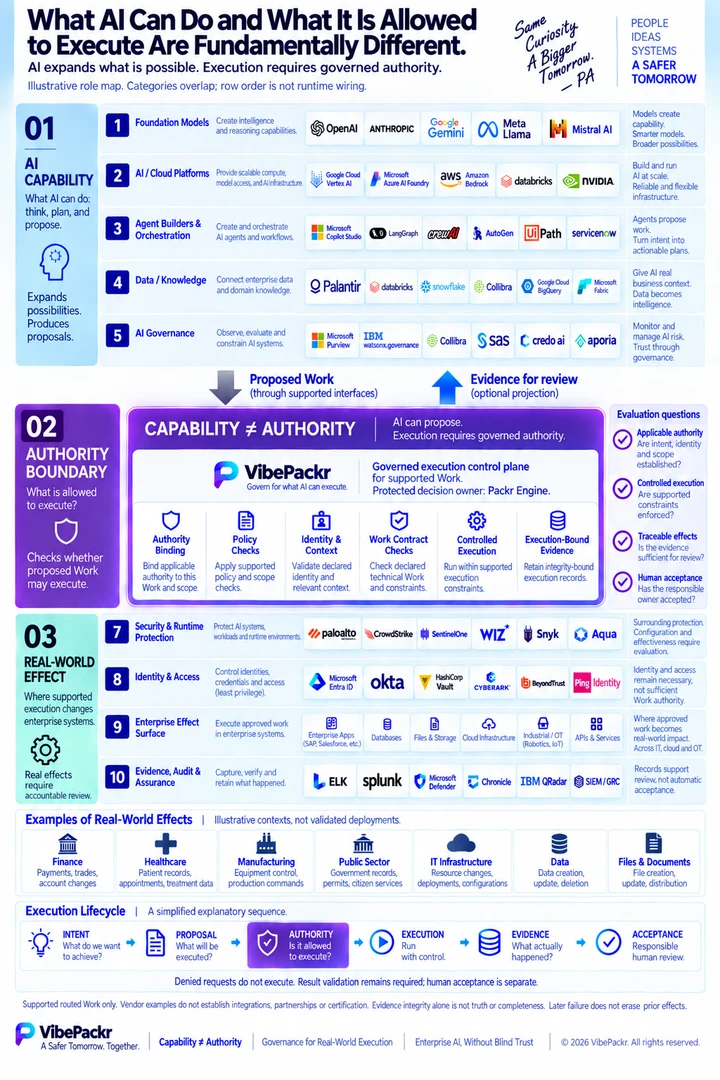
Three-band enterprise role map: AI Capability, a purple VibePackr Authority Boundary owned by Packr Engine, and Real-World Effect. Includes ten ecosystem categories, six protected responsibilities, seven illustrative industry contexts, and Intent, Proposal, Authority, Execution, Evidence and Acceptance as a conceptual lifecycle.
ILLUSTRATIVE CAPABILITY / AUTHORITY MAP

Capability is not authority.

AI can propose. Execution requires governed authority. Explore the boundary between AI capability and real-world effects, and why a successful technical result is not sufficient evidence of authorization.

Explore the detailed reference →
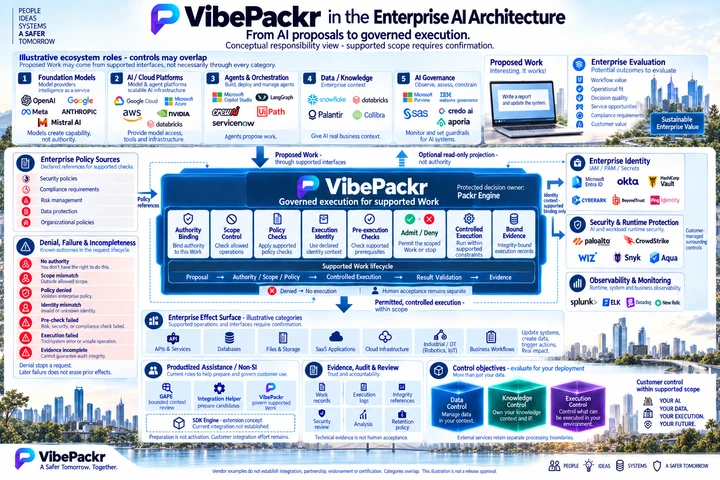
Detailed enterprise responsibility view showing optional preparation, declared policy references, Packr Engine governance, admission or denial, controlled execution, result validation, bound evidence, surrounding controls and an isolated SDK Engine concept with integration not established.
CONCEPTUAL RESPONSIBILITY VIEW

What does VibePackr govern?

A supported request reaches the protected Packr Engine with declared context, scope and applicable authority. Existing identity, security and observability remain surrounding controls. Preparation, execution, outcome review and human acceptance are related but separate responsibilities.

Explore the detailed reference →

Vendor names and logos identify illustrative examples, not confirmed integrations, partnerships, endorsements or certifications. Categories overlap. Availability and supported interfaces require confirmation. Then compare the deployment and trust boundaries →

TARGET OPERATING MODEL

Your environment. Your execution authority.

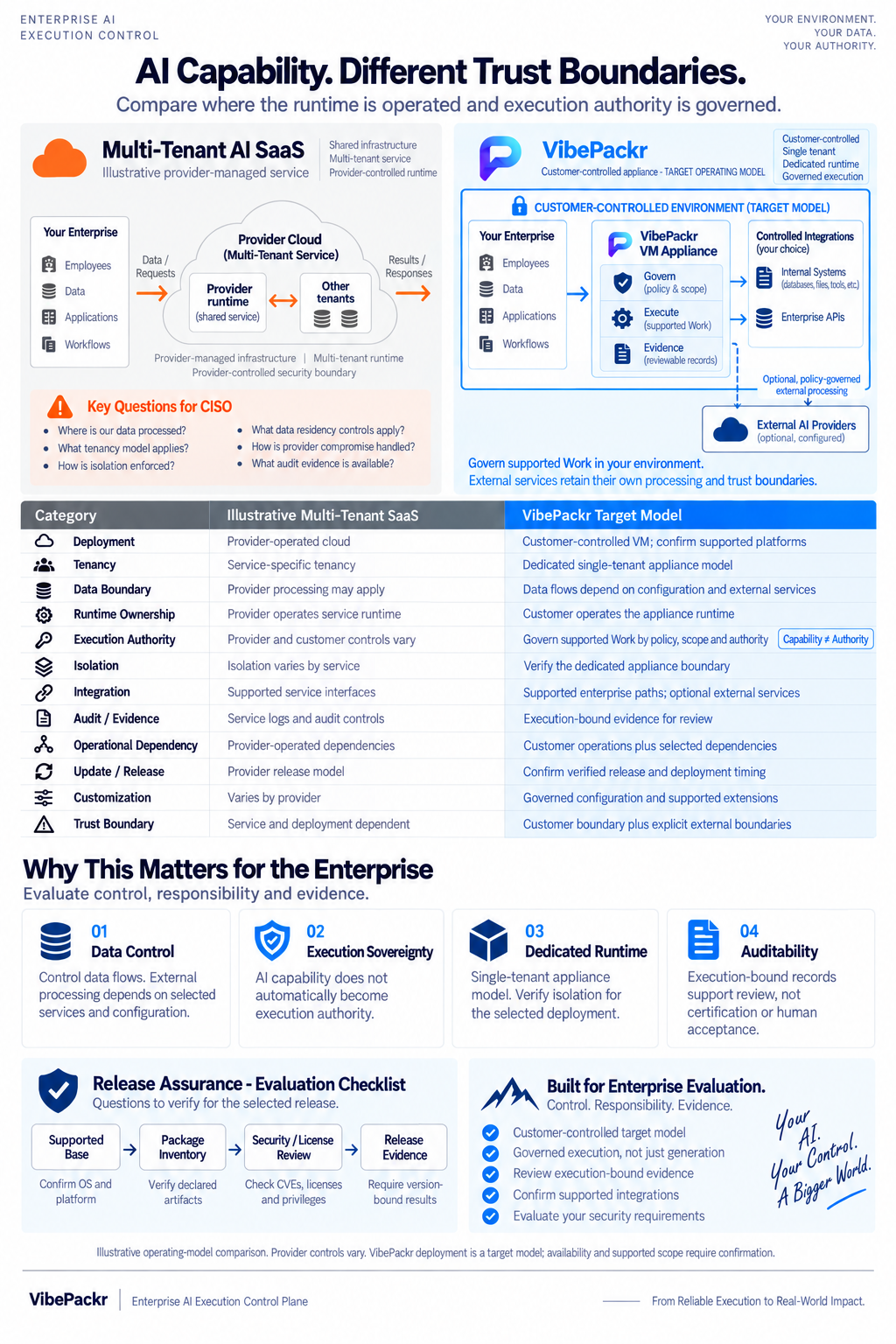
The customer-controlled appliance model places VibePackr's governed Work boundary in your environment. External AI services remain separate processing and trust boundaries; their use depends on supported paths, configuration and applicable policy.

  • Operate the boundary

    The target is a customer-operated, single-tenant appliance. Confirm the supported platform, tenancy boundary and operational responsibilities for your evaluation.

  • Govern supported Work

    Check authority, policy and scope for Work routed through the supported path. Model capability and access credentials do not by themselves authorize every operation.

  • Make external processing explicit

    Selecting an external AI service may involve external data processing. Identify the data flow, provider terms and relevant controls before use.

Provider controls vary by service and deployment. Availability, supported scope and release-specific validation require confirmation. This diagram does not change product, support, Marketplace or Legal status.

Illustrative comparison of provider-managed multi-tenant SaaS and VibePackr's customer-controlled target model, with external AI providers outside the customer boundary, twelve comparison categories, four evaluation considerations and a release-assurance checklist.
Figure 24 · Complete composition. Open the image to zoom, or read the accessible comparison.
An iceberg, with its visible peak supported by a much larger structure below the water.
BENEATH THE VISIBLE INTERACTIONSupported by explicit execution boundaries.Read the detailed iceberg reference →Conceptual illustration, not a product screenshot.
ONE RECORD, DIFFERENT QUESTIONS

Evidence supports a decision. It does not make it.

Engineering

What was requested, what ran, and which artifact resulted?

Security

Which authority and scope permitted the operation?

Operations & review

What evidence supports the outcome, and what remains to be accepted?

UNDERSTAND THE SCOPE

What this site describes

Evaluation baseline

Bounded technical scope

Current bounded implementation describes a reviewed technical scope, not a released package or customer production readiness. Confirm supported interfaces and versions for your evaluation.

Illustrative examples

Understand the workflow

Workflow stories and sample JSON explain the model. They are not customer production records or evidence of a completed deployment.

Target architecture

See the direction

Customer-controlled deployment is a target operating model. Historical SDK Engine implementation exists; current full Enterprise integration and support are not established. Future hosted/sharing concepts are distinct from bounded local Packtory.

ENTERPRISE REFERENCES

A clearer view of what matters.

Examine detailed source-based architecture diagrams, execution responsibilities and operating models, with full-resolution views and readable explanations.

Architecture & components →Execution & responsibility →Evaluation & operations →Future concepts — not current availability →
PRODUCTIZED ASSISTANCE · NON-SI

Standardize the boundary, not every customer's project.

Declarations, bounded reconciliation, preparation and common execution controls support a product model. They do not promise zero integration effort or transfer ownership of customer operations.

Customer-specific adapters, migrations, workflow design, production cutover and operations require named customer or implementation owners. Product defects remain within applicable product support scope.

Technical Whitepaper · English Edition · September 2026

VibePackr — Governed AI Execution for Enterprise Work

For enterprise architects, platform engineers, security reviewers, operators and business/technology owners. Explore architecture, authority, responsibility and evaluation boundaries through detailed diagrams—not certification or independent assurance.

Read the whitepaper (PDF)

49 pages · 26 figures · English · PDF · 50 MB · 28 September 2026

Technical reference; release-specific alignment remains under review.

Read the 3-page Executive Brief · View the Claim Index

Read the earlier 24-page edition — 22 September 2026

ILLUSTRATIVE ADOPTION SCENARIOS

Different starting points. One focused evaluation.

These are discussion scenarios, not customer case studies or promises of integration effort.

You already use an AI platform

Choose one agent workflow and identify which actions need explicit permission. Evaluate integration coverage before expanding scope.

Your tools span several systems

Map the request, policy owner, execution target, and evidence path. Start with a bounded workflow rather than a platform replacement.

Your team needs stronger review

Define the evidence and acceptance criteria with security and operations. Product records support review; they do not substitute for legal or regulatory assessment.

Before you evaluate

Does VibePackr replace my AI tools?

No. The architecture is designed to work alongside existing tools. Only requests routed through supported integrations are in scope; it does not imply universal interception of every tool action.

Does an evidence record guarantee a correct result?

No. Tamper-evident records help examine what happened. Business correctness, human acceptance, and contractual obligations remain separate.

Is this a managed operations service?

The draft support model is single-tenant, customer-controlled, and Non-SI. Contracted support scope and responsibilities are defined in the applicable agreement. Read the draft SLA.

Where are the technical diagrams?

The Architecture guide preserves the detailed BT-OS, headless execution, assurance, and target-domain material.

TECHNICAL EVALUATION

Start with one governed workflow.

Tell us which AI tools you use, what actions need approval, and where the work runs. Ask about the evaluation baseline and supported integration scope.

Request an Evaluation

Please do not include credentials, customer data, or confidential logs in your initial email.

Review the draft support SLA