Governed execution in the enterprise architecture
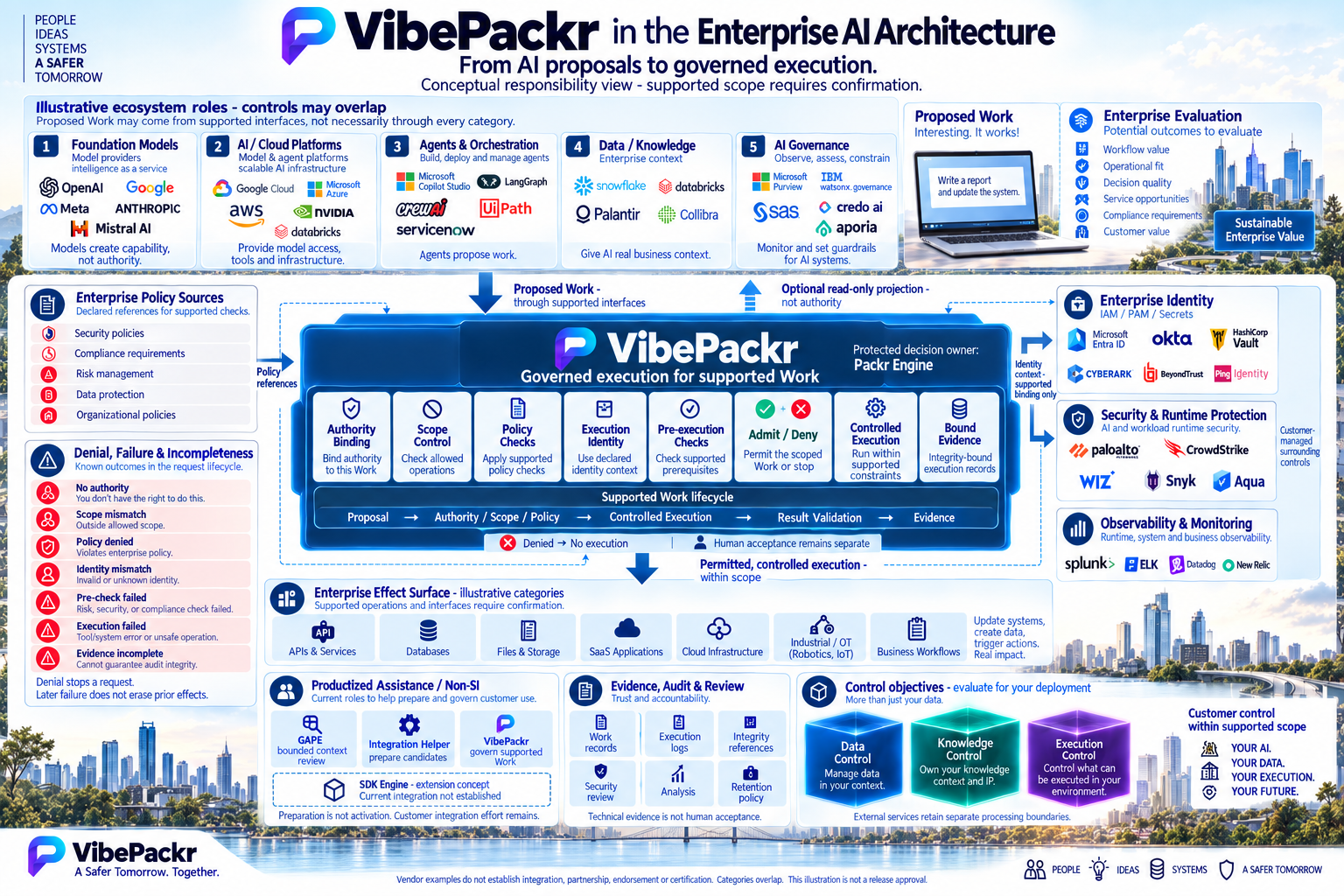
A supported request reaches the protected Packr Engine with declared context, scope and applicable authority. Existing identity, security and observability remain surrounding controls. Preparation, execution, outcome review and human acceptance are related but separate responsibilities.
English technical whitepaper · 26 September 2026 · Figure 26 · Page 48
Download the complete English image. Use your browser's Back button to return after opening an image.
Read the diagram in detail
Ecosystem roles are complementary
Models, platforms, agents, data and AI governance provide different, potentially overlapping capabilities. Their visual order is not a required sequence or evidence that each vendor has a live connection to VibePackr.
Declarations inform supported checks
Policy sources express requirements and references. The illustration does not claim automatic interpretation of arbitrary legal or organizational documents into enforceable policy. Scope, revisions and accepted formats still matter.
One protected decision owner
Packr Engine owns applicable protected governance and execution decisions. The central tiles describe related responsibilities, not separate authority engines. Identity, access, preparation and GUI actions do not independently grant Work authority.
Admission is not successful completion
Applicable authority, scope, policy and prerequisites are evaluated before permitted execution. A denied request does not execute. After execution, the observed result still needs validation and sufficient evidence; human acceptance remains separate.
Denial, failure and incompleteness differ
No authority, scope mismatch, policy denial, identity mismatch and failed prerequisites can prevent admission. Execution can later fail, and evidence can be incomplete. Neither later condition proves that no side effects occurred or that rollback succeeded.
Surrounding controls remain customer responsibilities
IAM, PAM, security tools and observability retain their own owners and conditions. Names and arrows are illustrative, not confirmed connectors or an always-on security guarantee. Read-only projections do not acquire decision authority.
Preparation is not activation
GAPE supplies bounded context review; Integration Helper prepares candidates and plans. These activities are not mandatory stages of every Work and do not automatically register, bind or authorize execution. SDK Engine has historical implementation evidence, but current full Enterprise integration and support are not established; no live SDK edge is asserted.
Non-SI is not zero integration effort
Productized Assistance provides standardized functions and guidance. Customer-specific adapters, workflow design, testing and operations retain named customer or implementation owners. Preparation does not promise completed integration.
Evidence supports review
Integrity-bound records help identify artifacts and detect changes. They do not independently prove all events were observed, certify regulatory compliance or replace human acceptance and closure decisions.
Control objectives need evaluation
Data, knowledge and execution control are objectives to evaluate for the selected deployment. External services retain separate processing boundaries. Business value, operational fit and compliance requirements need their own evidence.