Customer, VibePackr and third-party responsibilities
This explanatory guide describes a product boundary. It is not a contract, legal opinion, or amendment to the applicable agreement.
Technical Whitepaper · English Edition · September 2026 · Figure 10
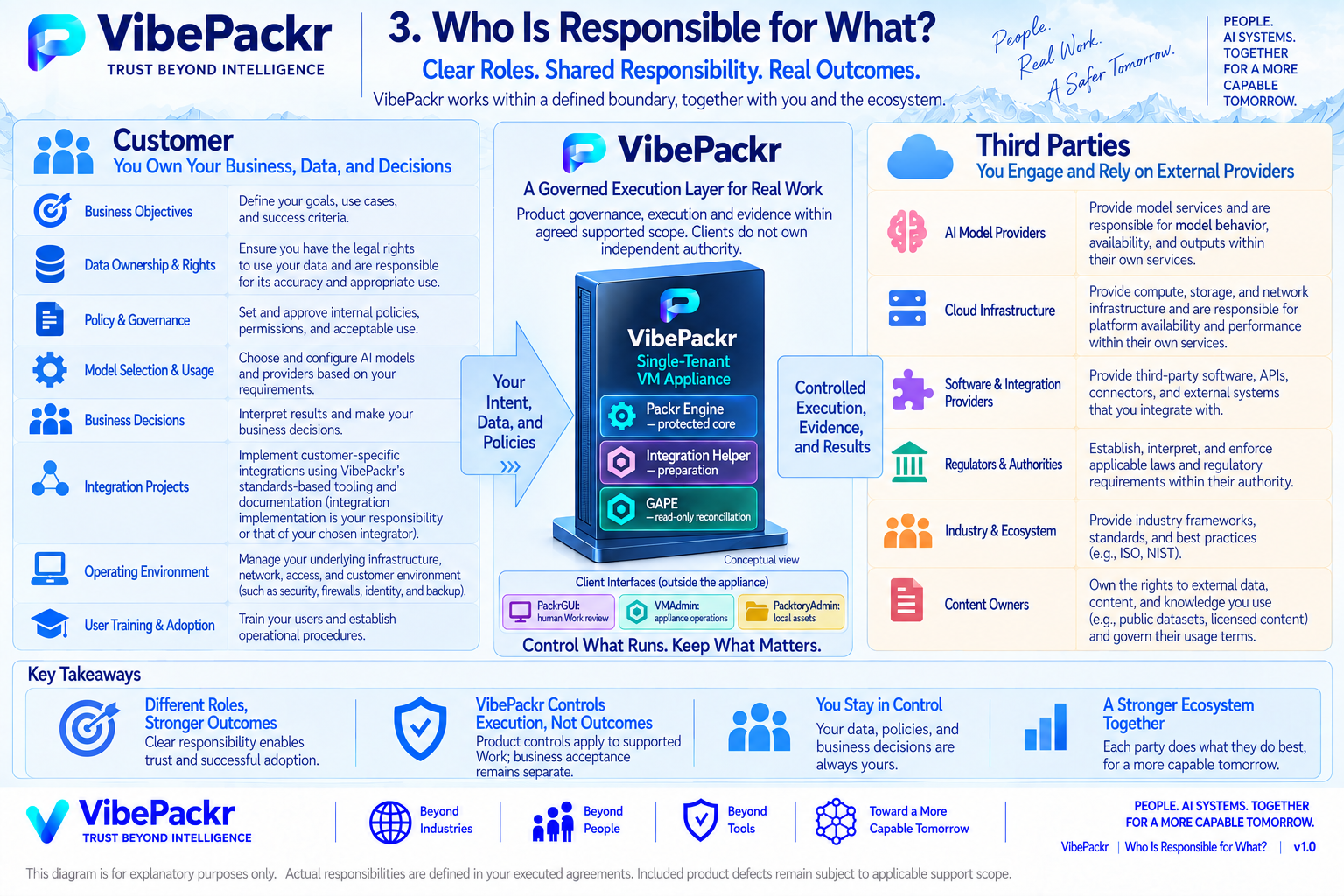
Open the full-resolution image to zoom; use your browser’s Back button to return. The complete plate is preserved; the explanation below remains readable without zooming.
Read the guide
A reading guide to the figure and its scope, not a claim of current implementation for every depicted concept.
Customer objectives, data and policy
The customer identifies business goals and success criteria, establishes rights to data, and approves organizational policies, permissions and acceptable use. Data availability alone is not authorization to process it.
Customer model choices and decisions
Model and provider selection, interpretation of results and final business decisions remain customer concerns. An execution record does not certify the truth of a model answer.
Integration, operations and adoption
The customer and appointed implementers own customer-specific adapters, migrations, workflow design, production cutover, infrastructure operations, data rights, access and training within their agreed scope. Productized Assistance does not assume those projects.
VibePackr product boundary
The protected core governs supported Work and evidence. Administration is a client role, not a GUI required inside the headless appliance. Included product defects remain within applicable support scope; Non-SI does not exclude every integration-related product defect.
Third-party services and infrastructure
Model providers, cloud providers and software providers operate under their own terms. Examples do not imply partnership, endorsement or a tested integration.
Authorities, ecosystem and content owners
Applicable law, external standards and content rights remain separate from product controls. A reference to ISO, NIST or HIPAA is not a certification or compliance claim.
Read alongside the legal documents
This role map is explanatory. Actual responsibilities follow applicable law and executed agreements. The published support SLA is a draft requiring legal review.
About this reference
Full composition from Figure 10 of the September 2026 English technical whitepaper. The full-resolution WebP preserves the source figure pixel-for-pixel; thumbnails are reduced previews only.
The whitepaper distinguishes bounded roles, conceptual architecture and future concepts. This reference does not establish release authorization, certification, legal approval or customer production outcomes.