"I understand the philosophy, but how does it fit into my actual workflow?"
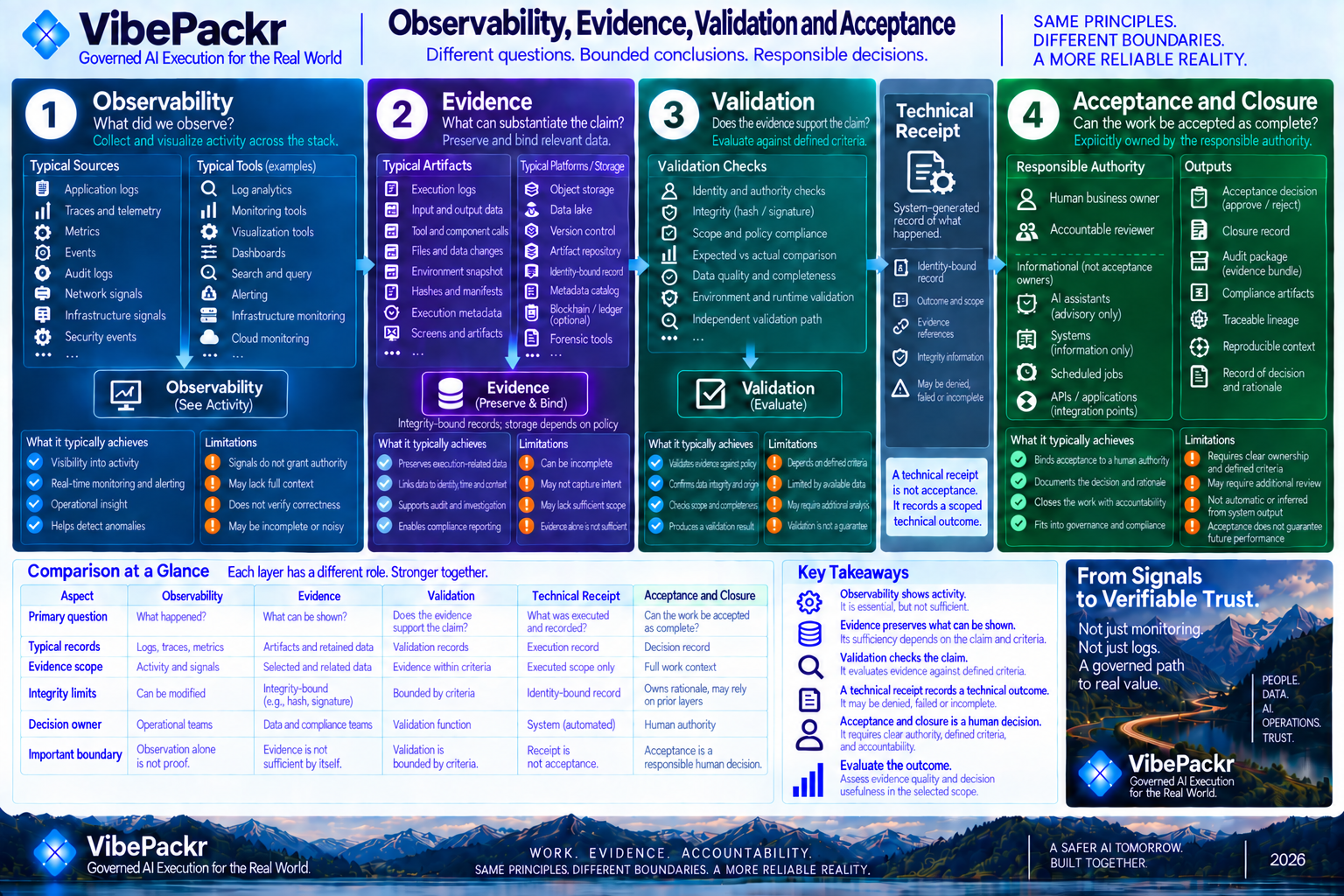
The illustrative journey is: an AI proposes Work → authority is evaluated → supported, authorized actions run → evidence supports validation and separate acceptance.
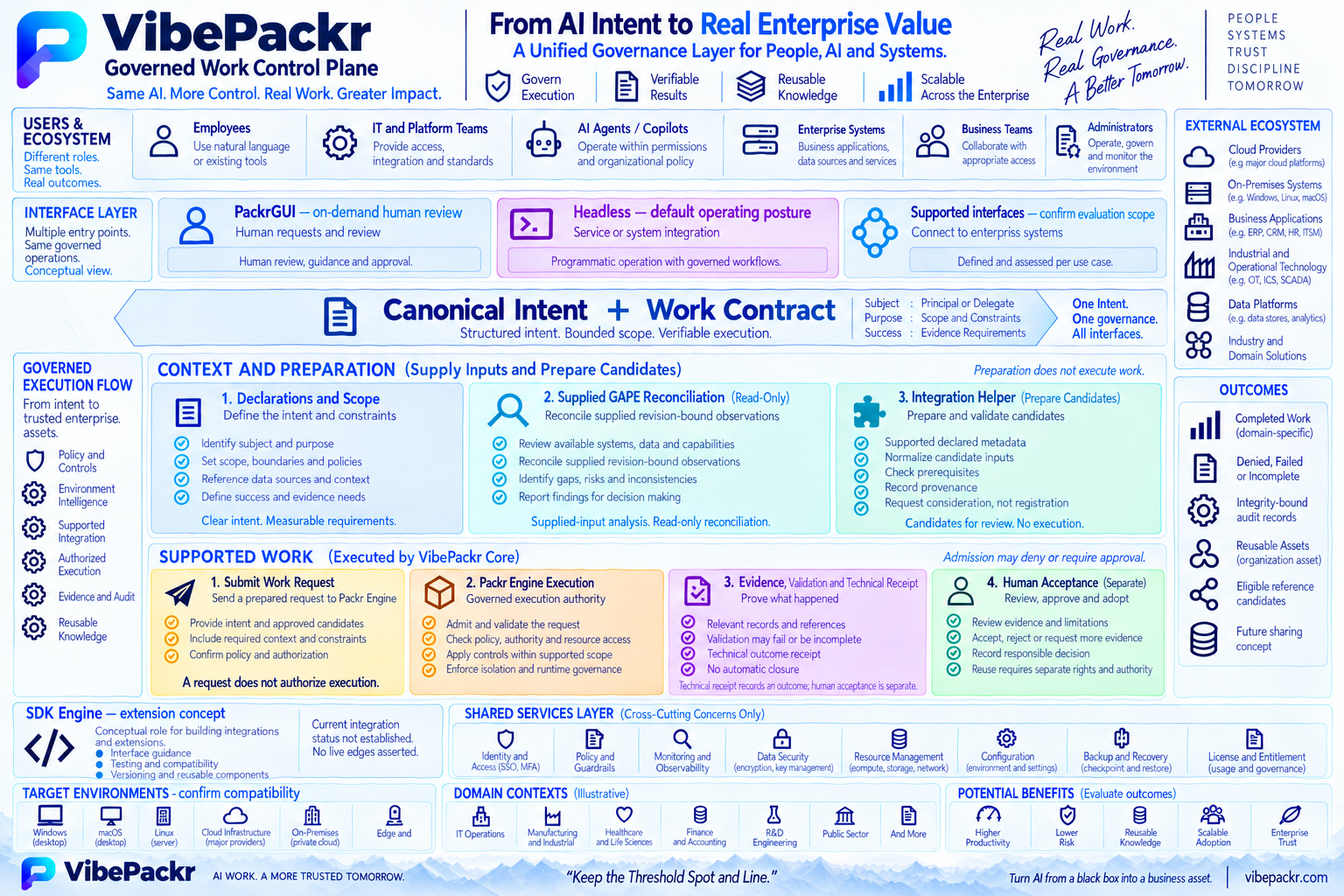
💡The Big Picture: How do people, AI models, and real systems interact safely?
AI models can generate ideas and proposals. Acting on enterprise resources requires a supported request path and explicit authority. VibePackr separates environment preparation from governed Work, with the protected Packr Engine owning governance and execution decisions.
✓
Intent In: Captures natural language requests and structured constraints from human operators.
✓
Governed Control Plane: Authority & Policy check, Runtime Context Binding, and Isolated Execution.
✓
Evidence Out: Governed executions produce tamper-evident records. Eligible, reviewed records may become reusable Pack candidates.
🔍 Click to Zoom (00)
Whitepaper Figure 23 · Full English reference plate. Read the classifications and scope notes; this is not an execution record.
STORY 01 / 08End-to-End Operational Lifecycle
From a Request to Real Execution
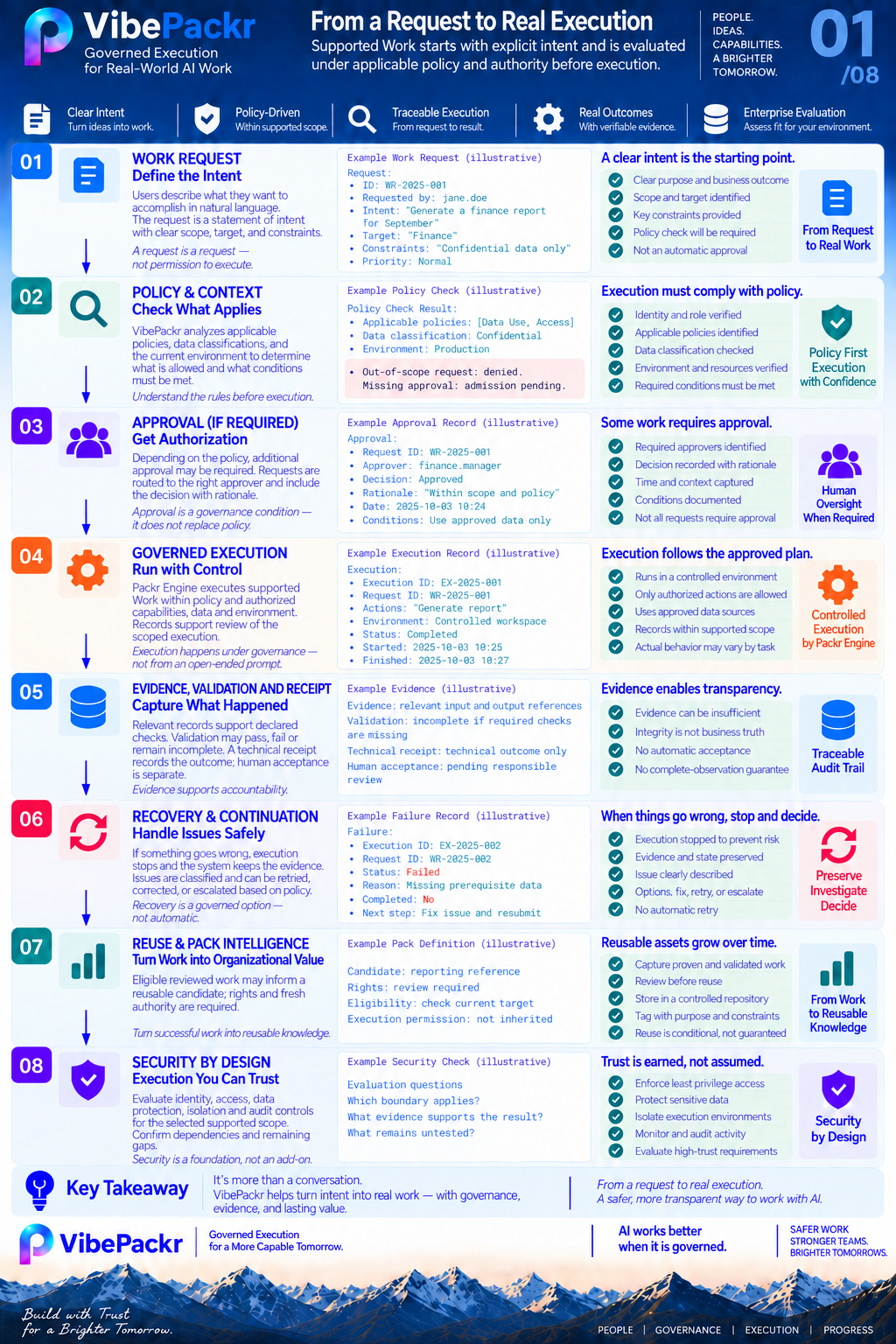
⚙️Illustrative Scenario: How should an AI request for a financial report be evaluated?
Jane Doe asks an AI assistant: "Generate the September financial report from ERP." The illustration asks how a supported, authorized reporting request would be scoped, evaluated, executed and reviewed. It does not establish ERP compatibility.
Work Request & Policy Check: Scope and constraints are captured; permissions are checked before any code executes.
2
Approval Routing: Admission may permit, deny or require approval under the applicable policy; a proposal does not grant permission.
3
Bounded Execution: The protected Packr Engine controls the supported, authorized execution path. Specific isolation behavior requires evaluation.
4
Receipt Issued: A technical outcome and relevant evidence are recorded. Business acceptance remains a separate decision.
🔍 Click to Zoom (01)
Whitepaper Figure 7 · Full English reference plate. Read the classifications and scope notes; this is not an execution record.
STORY 02 / 08Concurrency & Conflict Prevention
Two Agents, One Resource
🔀Real Challenge: What if Agent A and Agent B try to modify the same database simultaneously?
When multiple autonomous agents operate in parallel, uncoordinated access causes data corruption, race conditions, and deadlocks. The illustration considers resource overlap and ordering for supported, routed requests. Exact concurrency, queueing and isolation behavior must be confirmed for the selected workflow.
// Conflict Detection & Isolation Lane (Example)JSON Trace
Illustrative example — not an actual execution record or production evidence.
Conflict Detection: Identify overlap and dependencies for the scoped evaluation; this example does not prove universal conflict detection.
✓
Isolated Execution Lanes: The example depicts bounded workspaces. Supported resource controls and limits require workflow-specific validation.
✓
Clean Release: Check resource disposition and prerequisites before subsequent Work; the illustration is not scheduler or timing proof.
🔍 Click to Zoom (02)
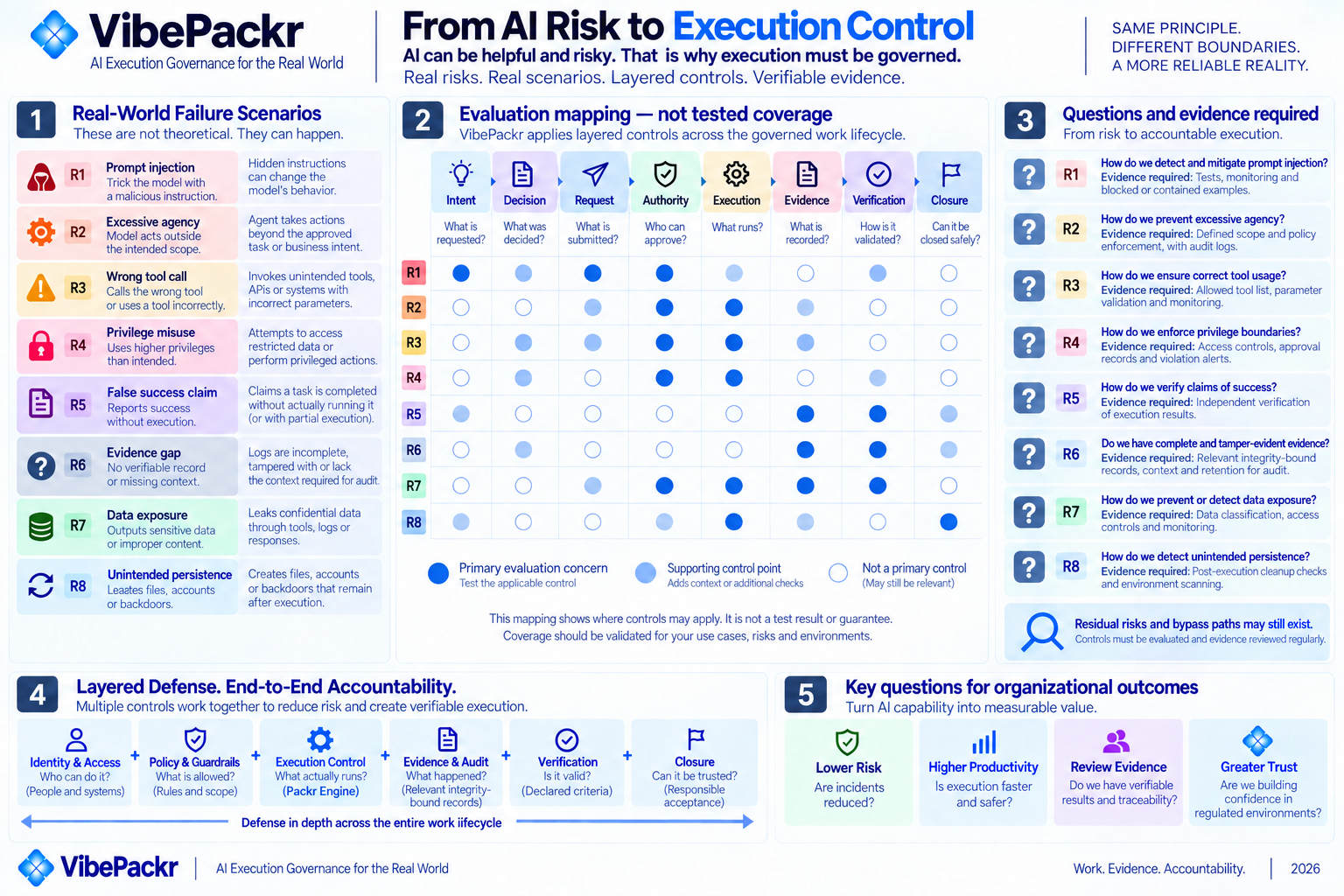
Whitepaper Figure 18 · Full English reference plate. Risk evaluation questions, not a validated scheduler or conflict-prevention guarantee.
STORY 03 / 08Role Separation & Safety
AI Recommendation ≠ Execution Authority
🛡️Core Principle: How do you prevent unauthorized execution of erroneous or unsafe AI proposals?
LLMs are stochastic text generators; they must never possess inherent authority to execute tools. VibePackr strictly separates Proposal from Authority. An AI can suggest multiple approaches, but only authorized operations can execute.
✓
AI Proposes: Model suggests Candidate A (generate financial report) and Candidate B (export raw customer CSV).
✓
VibePackr Evaluates: Candidate B requires evaluation against the applicable export policy. The decision may deny the request or require approval; approval never overrides a policy prohibition.
✓
No Implicit Execution: Only the approved, policy-compliant candidate is passed to the execution runtime.
🔍 Click to Zoom (03)
Whitepaper Figure 8 · Full English reference plate. Read the classifications and scope notes; this is not an execution record.
STORY 04 / 08Auditability & Transparency
Why Was This Allowed?
🔍Audit Reality: When security asks "Why did this run?", how do you answer?
Recorded governance decisions make requests, evaluated policies, and enforced constraints available for review within the supported execution scope.
// Decision Record (Human-Readable Reason)JSON Trace
Illustrative example — not an actual execution record or production evidence.
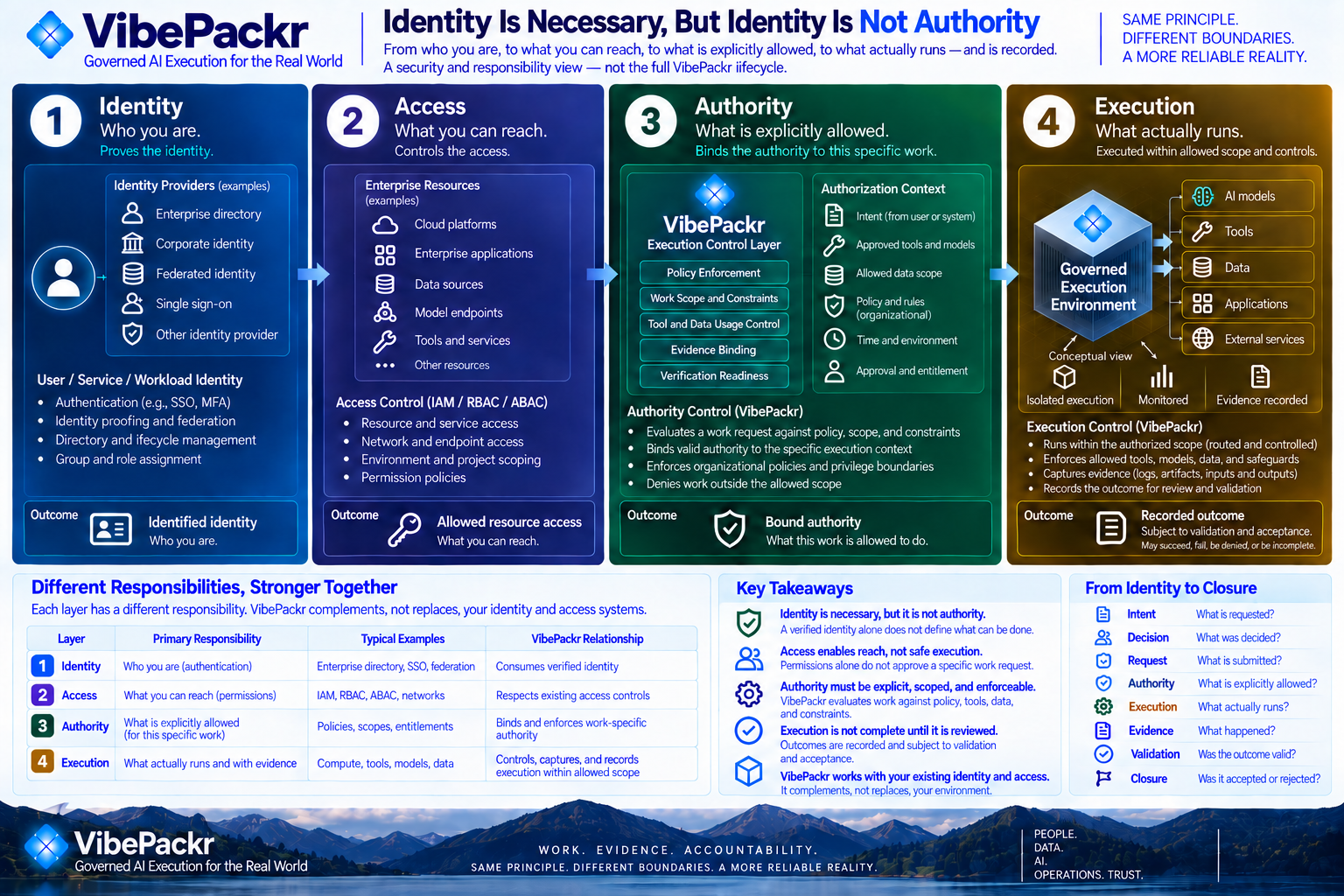
Whitepaper Figure 8 · Full English reference plate. The identity/authority plate is repeated here to support decision review.
STORY 05 / 08Evidence & Integrity
Result, Evidence, and Traceability
📜Integrity Verification: How do we verify that execution records and outputs have not been altered?
Evidence is not just a chat transcript. Relevant execution records and declared checks support bounded review. Digests and provenance can help detect changes; they do not independently prove source truth, complete observation, business correctness or final acceptance.
// Evidence Record & Artifact HashesCryptographic Receipt
Illustrative example — not an actual execution record or production evidence.
Tamper-Evident Hashes: Digests can bind selected records and help detect changes within the checked scope; they are not universal truth or completeness guarantees.
✓
Traceability & Separate Decisions: Review the available request, authority, execution and validation records. A technical receipt is not human acceptance or automatic closure; evidence can be incomplete.
🔍 Click to Zoom (05)
Whitepaper Figure 9 · Full English reference plate. Read the classifications and scope notes; this is not an execution record.
STORY 06 / 08Adoption & Integration
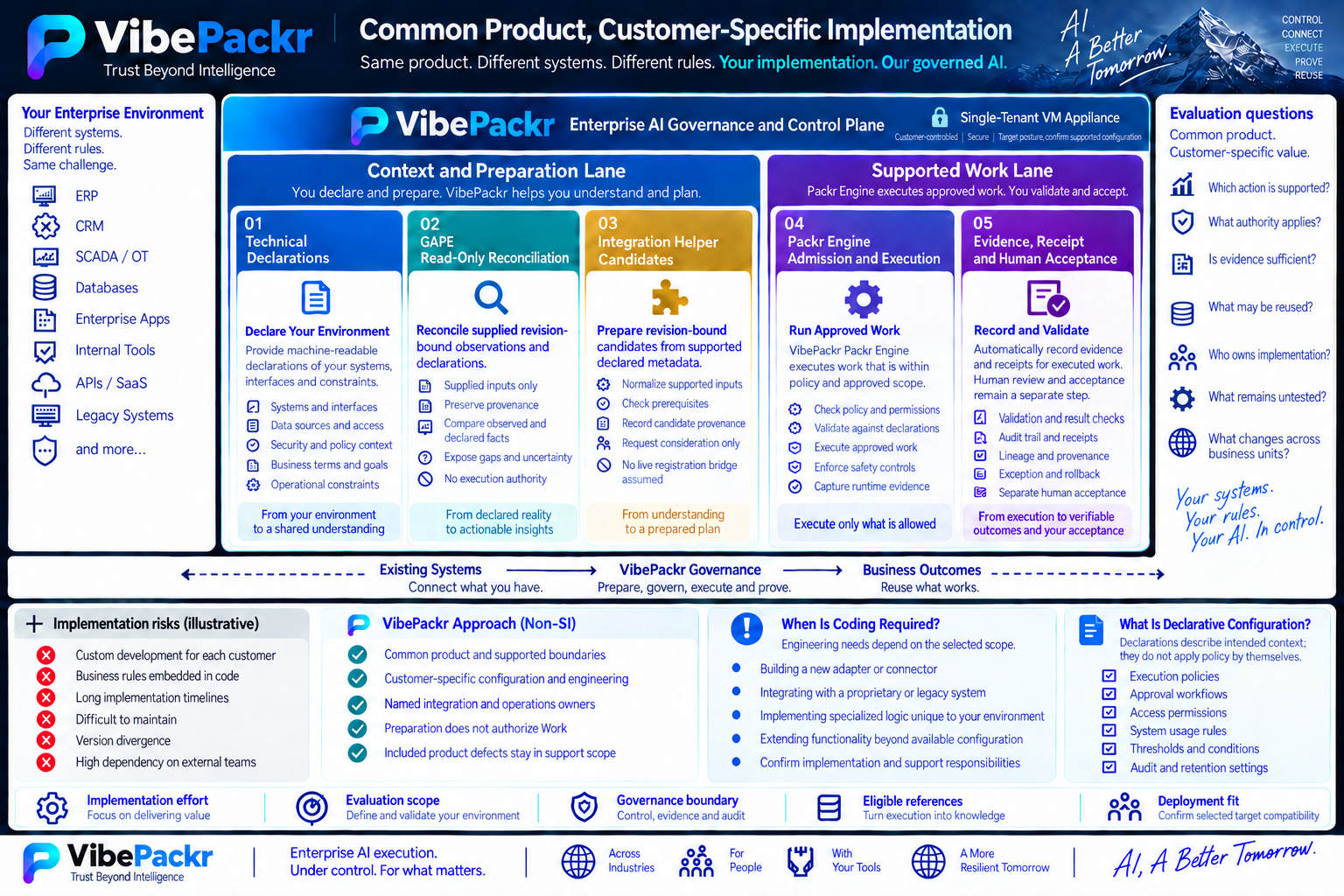
Prepare a supported enterprise connection
🔌Integration Architecture: How does VibePackr connect to enterprise tools and clouds?
Begin with authorized context and supported interfaces. Integration Helper prepares candidates from declared metadata; it does not discover arbitrary systems, register live bindings or grant execution permission. Customer-specific implementation requires an assigned owner.
1
Bounded reconciliation (GAPE): Compares revision-bound observations and declarations, with separately scoped operator-side Git/Rust/Tauri source discovery and offline viewers. Headless inspection uses supplied snapshots; GUI remains R0. No universal discovery or automatic remediation is implied.
2
Integration Helper: Prepares candidates from supported metadata; preparation is not registration, binding or authority.
3
Conditional extension: Custom adapter work needs an implementation owner. Historical SDK Engine implementation exists; current integration status not established. Current full Enterprise support is also unestablished. No live SDK dependency is assumed.
4
Target deployment posture: Customer-controlled, single-tenant VM appliance with headless-first operation. Provider compatibility and supported versions require separate confirmation.
🔍 Click to Zoom (06)
Whitepaper Figure 17 · Full English reference plate. Read the classifications and scope notes; this is not an execution record.
Product and implementation boundaries: Figure 17 distinguishes the common product from customer-specific work. It is not connector coverage, an included SI service or a delivery commitment.
STORY 07 / 08Cumulative Knowledge & Target Architecture
From Completed Work to Pack Intelligence
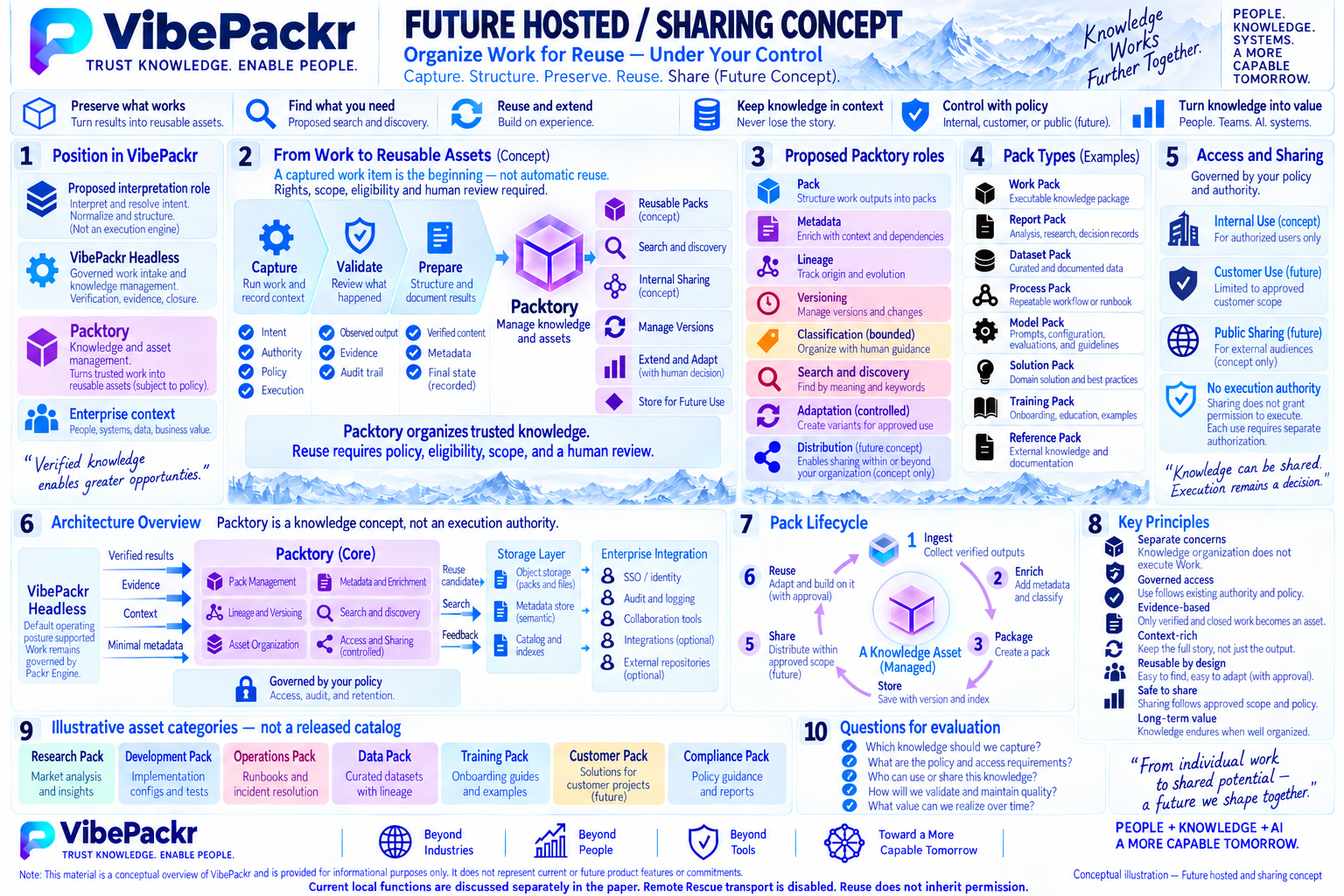
📦Cumulative Knowledge: How can verified executions benefit the wider organization?
A prior result may inform a reusable candidate only after rights, sensitivity, scope and eligibility review. Bounded local Packtory functions are distinct from the future hosted/sharing concept shown here. Stored knowledge never inherits permission for a new execution.
1
Bounded Local Functions: Local asset discovery, consumption and governed administration do not establish automatic learning, hosted publishing or unrestricted reuse of customer work.
2
Future Hosted Packtory & Sharing: Hosted storage, search, distribution and sharing are future concepts, not available services or delivery commitments.
3
Evidence for Later Review: Earlier evidence can inform a later candidate or review. It does not transfer permission to another customer, target or operation.
4
Sovereign Institutional Memory: Data rights, sensitivity, processing and redistribution permission require independent review. Stored knowledge is not automatically eligible for reuse.
🔍 Click to Zoom (07)
Whitepaper Figure 12 · Full English reference plate. Read the classifications and scope notes; this is not an execution record.
Conceptual Target Architecture: Depicts the conceptual lifecycle from execution to organizational knowledge. Bounded local Packtory asset discovery, consumption and governed administration are distinct from the wider future hosted/sharing concept. Reuse never inherits execution permission; remote Rescue transport remains disabled.
STORY 08 / 08Governed AI Execution at Enterprise Scale
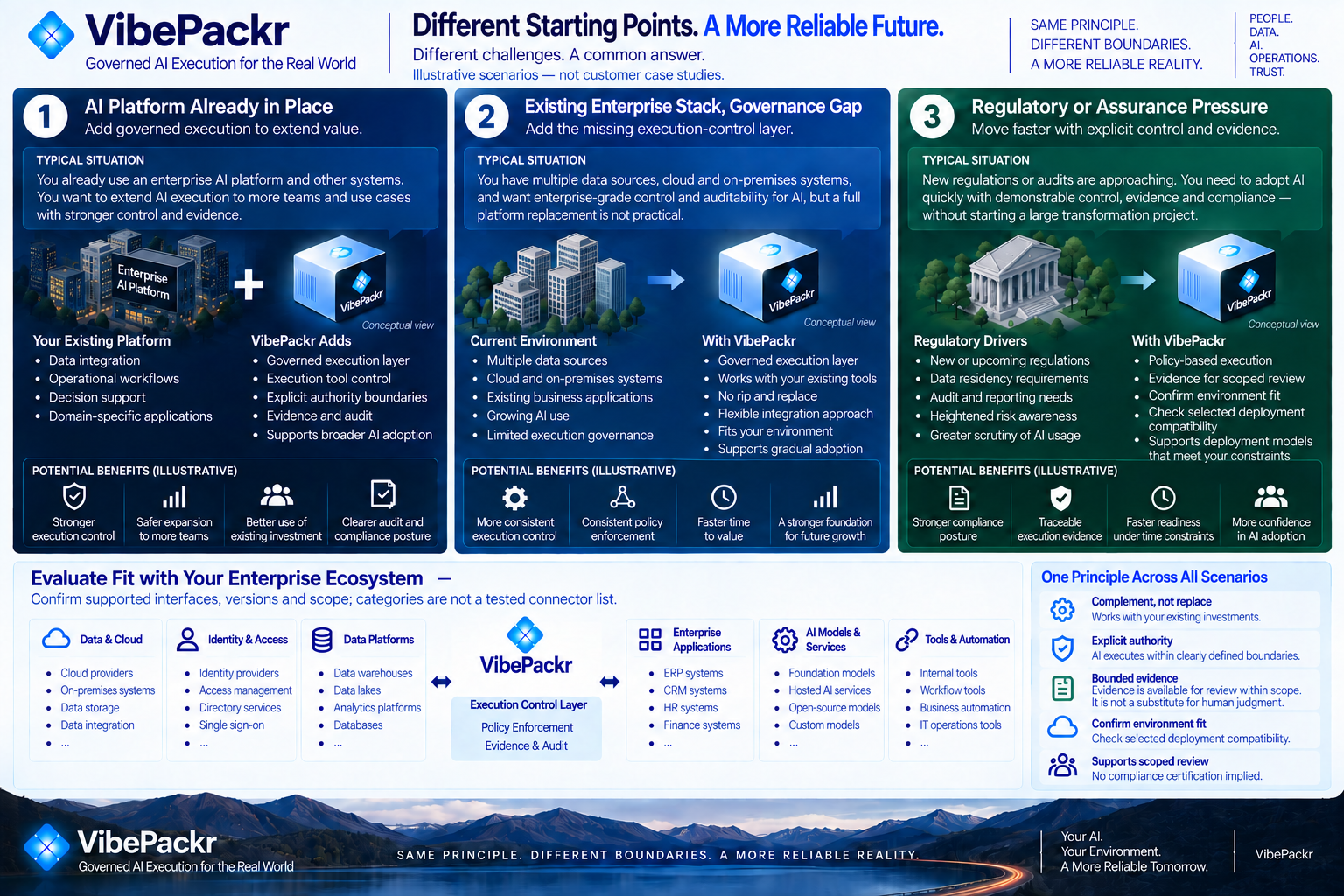
Evaluate first. Expand only with evidence.
🏢Scale & Trust: How does VibePackr scale from pilot teams to enterprise-wide adoption?
A bounded evaluation should establish one useful workflow, its conditions and unresolved limits. Wider adoption requires a separate decision; this illustration is not evidence of customer scale, cloud portability or a business outcome.
1
Start Small (Define the Test): Agree the workflow, owners, exclusions and evaluation criteria before testing.
2
Evaluate the Next Scope: A new team, data source or workflow needs its own supported-interface, rights, authority and outcome criteria. Department labels are illustrative, not tested coverage.
3
Operational Readiness: Establish infrastructure and implementation owners, access, data handling, monitoring and recovery criteria. Commercial support commitments remain contract-specific.
4
Multi-Cloud & Beyond: Additional environments require supported-version, access, compatibility and operational evaluation; portability is not established by this illustration.
🔍 Click to Zoom (08)
Whitepaper Figure 13 · Full English reference plate. Read the classifications and scope notes; this is not an execution record.
Ready to Evaluate Governed AI Execution?
Establish one supported workflow, its authority boundary, evidence criteria and named responsibility owners.
Contact our technical architecture team for evaluation baselines and deployment documentation.