One architecture.
Three ways to read it.
Where does a component belong, when does it participate, and what can it control? VibePackr’s 3D Architecture Space places those questions in one coordinate model, from interfaces and preparation through governed execution, evidence and recovery.
Position defines role. Volume defines responsibility. Connections define governed interaction.
Role, participation and control
Independent boxes occupy a shared Cartesian volume. Their sizes describe qualitative responsibility coverage; they do not measure capacity, performance or an amount of permission.
What kind of control?
Observe Only → Scoped → Authorized → Bound / Enforced → Autonomous Within Policy.
Interfaces remain at the observe/input end; the Engine occupies the enforcement region. X4 is deliberately unoccupied in this projection.
When does it participate?
Understand → Prepare → Authorize → Bind → Execute → Observe → Verify → Close → Recover.
A longer box spans more responsibilities across work. This is a participation map, not the exact persisted state-machine sequence.
Which architectural role?
Interfaces · Architecture / Integration · Policy & Authority · Runtime / Execution · Observation · Evidence & Trust · External Effect.
Box color identifies the primary plane. A function can involve other planes while keeping the same protected decision owner.
Explore the complete architecture space
Start with the axes at the shared origin. Find a numbered box, then use the component key below. Open the viewer to enlarge fine details, or download the A4 PDF for print.
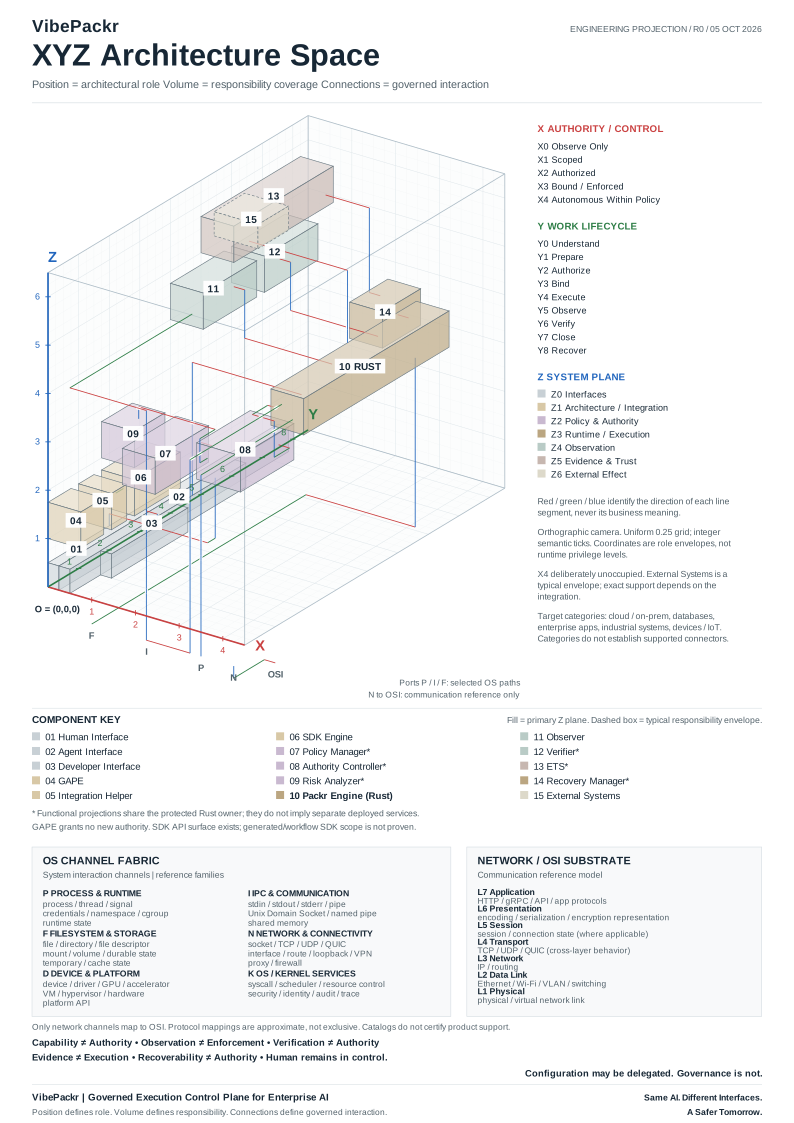
How to read a line
Every segment changes one coordinate. Its color shows that axis—not whether the connection is trusted, successful or active.
- Red: X-direction movement
- Green: Y-direction movement
- Blue: Z-direction movement
A single connection can change color at a bend. No arrowhead or intersection grants authority; a visual crossing alone does not establish a shared interface.
Keep the boundaries visible
The dashed External Systems box is a typical target envelope. It has no universal execution link. The OS and network references below are outside the product’s Z planes.
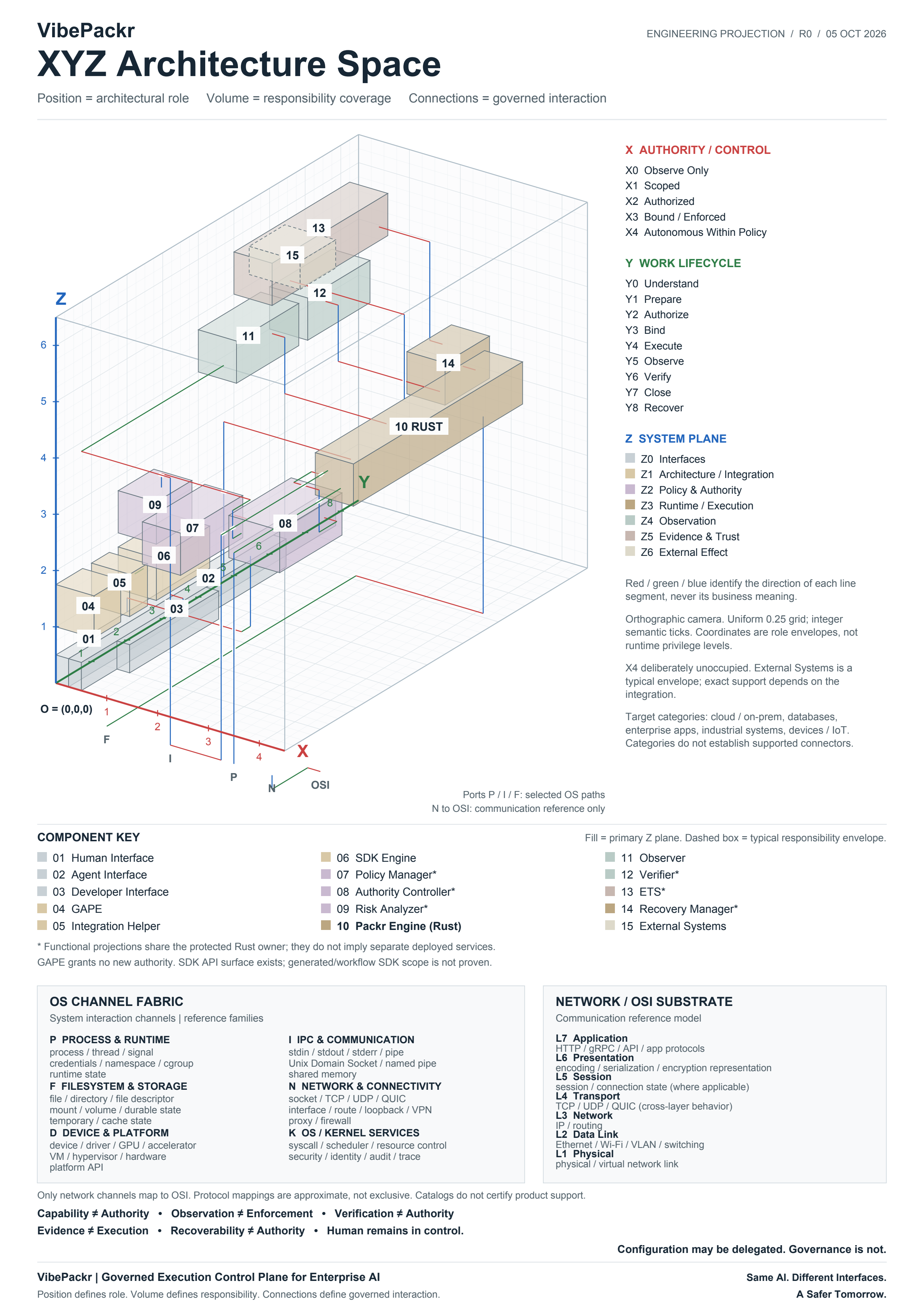
Fifteen roles, distinct responsibilities
The numbers match the diagram. Names such as Policy Manager and Authority Controller identify functional responsibilities. They do not imply separately deployed products.
- 01
Human Interface
Provides intent, review and acceptance input across work. Human decisions enter through supported checks; using a screen does not independently authorize execution.
- 02
Agent Interface
Submits typed requests and queries results. An agent’s ability to propose work does not bypass admission or acquire execution authority.
- 03
Developer Interface
Supplies declarations and bounded integration input in the Prepare / Bind region. Extension capability remains separate from permission to execute.
- 04
GAPE
Supports discovery and architectural understanding near Understand. Its observations inform preparation; it creates no new product authority.
- 05
Integration Helper
Checks and organizes supported input for bounded integration preparation. A prepared candidate or plan is not a connected, registered or authorized runtime integration.
- 06
SDK Engine
Represents the public typed extension and compatibility surface. Existing API evidence does not establish every generated SDK, complete workflow integration or customer delivery route.
- 07
Policy Manager
Represents policy definition and constraint inputs before execution. Applicable protected decisions remain within Packr Engine.
- 08
Authority Controller
Represents identity, scope, admission and binding checks around Authorize / Bind. It shares the protected Rust owner with execution governance.
- 09
Risk Analyzer
Supplies risk-evaluation inputs to governed admission. Its analysis is not an independent source of permission or a guarantee of risk-free operation.
- 10
Packr Engine (Rust)
Owns protected governed-execution decisions, transitions and closure gates. Its Bind → Execute → Close span places enforcement at the center of this view.
- 11
Observer
Reads typed status and work observations around Execute / Observe. Read-only visibility is not enforcement authority and cannot approve work.
- 12
Verifier
Represents result and evidence validation around Verify / Close. Validation decisions retain their protected owner; verification does not grant execution authority.
- 13
ETS
The Evidence & Trust role covers identity, integrity, lineage and retention in scoped product-asset paths. This does not imply every Work has an ETS reference or that evidence is execution.
- 14
Recovery Manager
Represents authorized backup, restore and state reconciliation near Close / Recover. Current operation authority is still required; arbitrary external undo is not asserted.
- 15
External Systems
A customer-controlled target boundary: cloud, on-premises systems, databases, enterprise applications or other applicable targets. Categories are not a list of proven connectors or universal industrial/device support.
One request, from preparation to review
Imagine preparing one bounded read operation. The sequence below explains the roles; it is not a newly executed end-to-end run, an automatic pipeline or a required path for every Work.
- 1
Understand the target · 04
Use available GAPE observations to review components and relationships. Establish what the intended operation needs. Observed structure supplies context, not permission.
Read the GAPE review example → - 2
Prepare supported input · 03, 05, 06
Describe the capability through a supported declaration. Review the Helper’s candidate, missing requirements or denial. A successful discovery result does not establish successful normalization or integration.
Inspect declaration and Helper JSON examples → - 3
Evaluate authority and binding · 07, 08, 09, 10
Before a supported execution, exact identity, scope, applicable constraints and prerequisites must be evaluated. Preparation does not automatically register, bind or authorize the operation.
Read the preparation-to-execution boundary → - 4
Inspect the recorded outcome · 10, 11, 12, 13
For admitted work, follow its exact identity through status, result validation and available evidence. Read the retained Headless example for an actual local run; keep its stated version and scope limits.
Follow the retained Headless run → - 5
Review, close or recover within authority · 01, 14
Open the corresponding report, inspect its revision and distinguish validation from human acceptance. Recovery is a separately governed operation; a failure alone does not prove rollback or erase earlier effects.
Follow Audit Report discovery and review →
The examples are separate records. The linked Helper, Headless and GUI examples explain their own observed results. They are not presented as one continuous execution or a newly validated customer deployment.
Two references outside the XYZ volume
Operating-system interaction and network communication are related but different. A file write or local IPC exchange does not necessarily traverse a network stack.
OS Channel Fabric
Six channel families organize process/runtime, IPC, filesystem/storage, network, devices/platforms and OS/kernel services.
Selected lines show governed process launch, typed local IPC and durable state persistence. Observer’s selected IPC relationship is read-only. Unlinked channel categories are reference context, not claimed direct access.
Network / OSI communication reference
The seven-layer reference describes communication concepts from application protocols to physical or virtual network links.
Only the network channel family connects to this reference. Modern protocols such as QUIC cross traditional boundaries; the labels do not assert exclusive mappings or product support for every listed protocol.
A structural explanation with explicit limits
The diagram was reconciled with implementation and contract evidence. It is a responsibility projection, not a deployment inventory, new runtime test, supported-connector catalog or release authorization.
- Capability ≠ Authority
- Observation ≠ Enforcement
- Verification ≠ Authority
- Evidence ≠ Execution
- Recoverability ≠ Authority
Human remains in control.
Configuration may be delegated. Governance is not.
No certification, performance result, customer deployment or new provider execution is asserted by this projection. X4 is unoccupied here; that drawing choice is not a finding that a capability is absent. Supported scope and availability remain specific to the selected release and deployment.
Governed Execution Control Plane for Enterprise AI
Same AI. Different Interfaces. A Safer Tomorrow.