Deployment and trust boundaries
The customer-controlled appliance model places VibePackr's governed Work boundary in your environment. External AI services remain separate processing and trust boundaries; their use depends on supported paths, configuration and applicable policy.
English technical whitepaper · 26 September 2026 · Figure 24 · Page 46
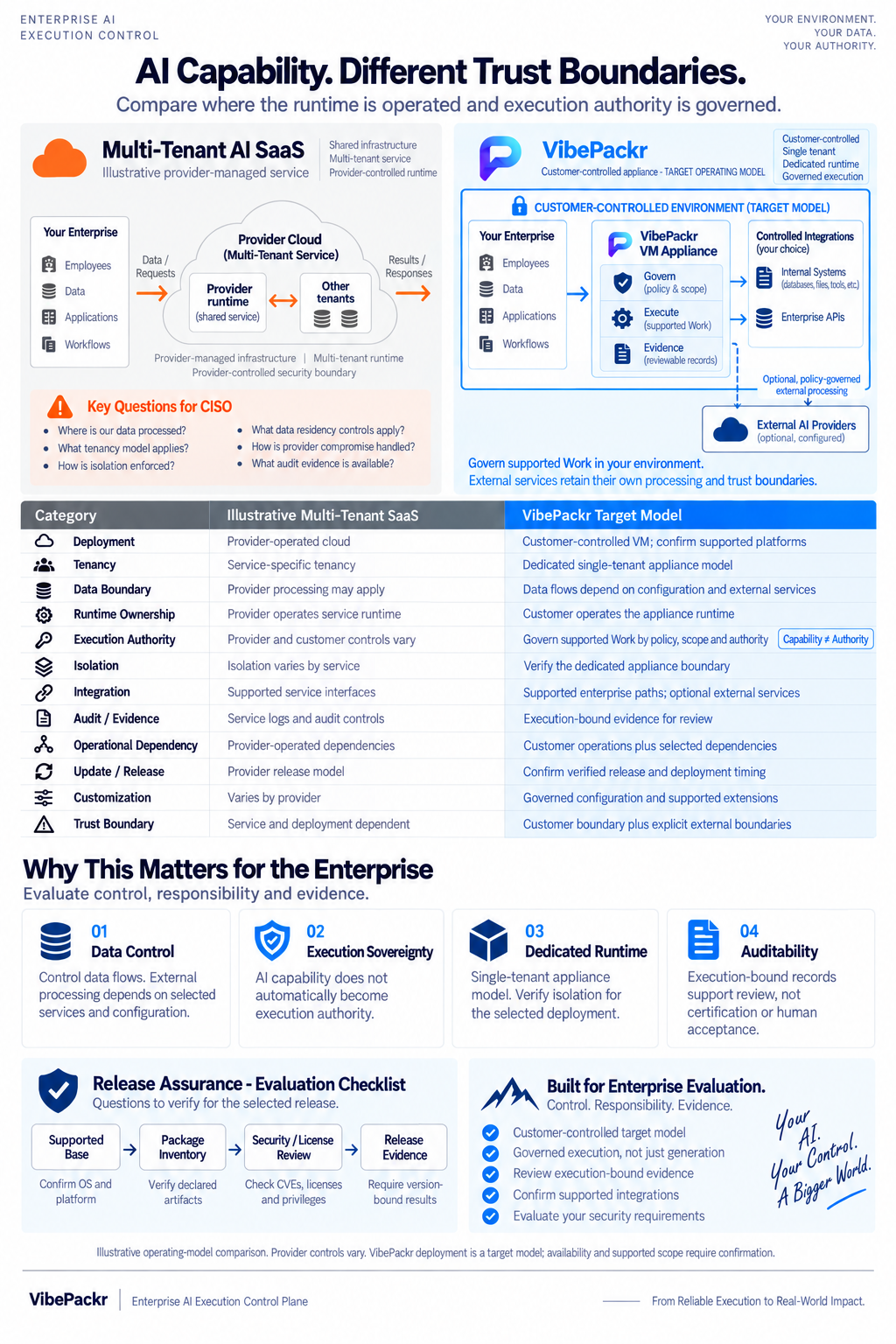
Download the full English image. Use your browser's Back button after opening an image to return.
Read the boundary correctly
Operate the boundary
The target is a customer-operated, single-tenant appliance. Confirm the supported platform, tenancy boundary and operational responsibilities for your evaluation.
Govern supported Work
Check authority, policy and scope for Work routed through the supported path. Model capability and access credentials do not by themselves authorize every operation.
Make external processing explicit
Selecting an external AI service may involve external data processing. Identify the data flow, provider terms and relevant controls before use.
Compare the operating models
These are illustrative responsibility patterns. A provider's controls depend on the selected service and deployment; the VibePackr column describes the target model, not general availability.
- Deployment
- Illustrative Multi-Tenant SaaSProvider-operated cloud
- VibePackr Target ModelCustomer-controlled VM; confirm supported platforms
- Tenancy
- Illustrative Multi-Tenant SaaSService-specific tenancy
- VibePackr Target ModelDedicated single-tenant appliance model
- Data Boundary
- Illustrative Multi-Tenant SaaSProvider processing may apply
- VibePackr Target ModelData flows depend on configuration and external services
- Runtime Ownership
- Illustrative Multi-Tenant SaaSProvider operates service runtime
- VibePackr Target ModelCustomer operates the appliance runtime
- Execution Authority
- Illustrative Multi-Tenant SaaSProvider and customer controls vary
- VibePackr Target ModelGovern supported Work by policy, scope and authority
- Isolation
- Illustrative Multi-Tenant SaaSIsolation varies by service
- VibePackr Target ModelVerify the dedicated appliance boundary
- Integration
- Illustrative Multi-Tenant SaaSSupported service interfaces
- VibePackr Target ModelSupported enterprise paths; optional external services
- Audit / Evidence
- Illustrative Multi-Tenant SaaSService logs and audit controls
- VibePackr Target ModelExecution-bound evidence for review
- Operational Dependency
- Illustrative Multi-Tenant SaaSProvider-operated dependencies
- VibePackr Target ModelCustomer operations plus selected dependencies
- Update / Release
- Illustrative Multi-Tenant SaaSProvider release model
- VibePackr Target ModelConfirm verified release and deployment timing
- Customization
- Illustrative Multi-Tenant SaaSVaries by provider
- VibePackr Target ModelGoverned configuration and supported extensions
- Trust Boundary
- Illustrative Multi-Tenant SaaSService and deployment dependent
- VibePackr Target ModelCustomer boundary plus explicit external boundaries
Four questions for enterprise evaluation
Data control
Which data stays in your environment, and which data is processed by selected external services?
Execution sovereignty
Who may approve this particular Work, for which target and scope?
Dedicated runtime
What isolation boundary is actually configured and validated for the selected appliance deployment?
Auditability
What execution-bound records support review? Evidence does not itself establish certification or human acceptance.
Release assurance: an evaluation checklist
The steps below identify evidence to request. They do not report completed security checks or announce an approved release.
- Supported base: confirm the supported operating system and platform.
- Package inventory: verify the declared artifacts and their identities.
- Security and license review: inspect relevant CVE, licensing and privilege-review results.
- Release evidence: require results bound to the selected version.