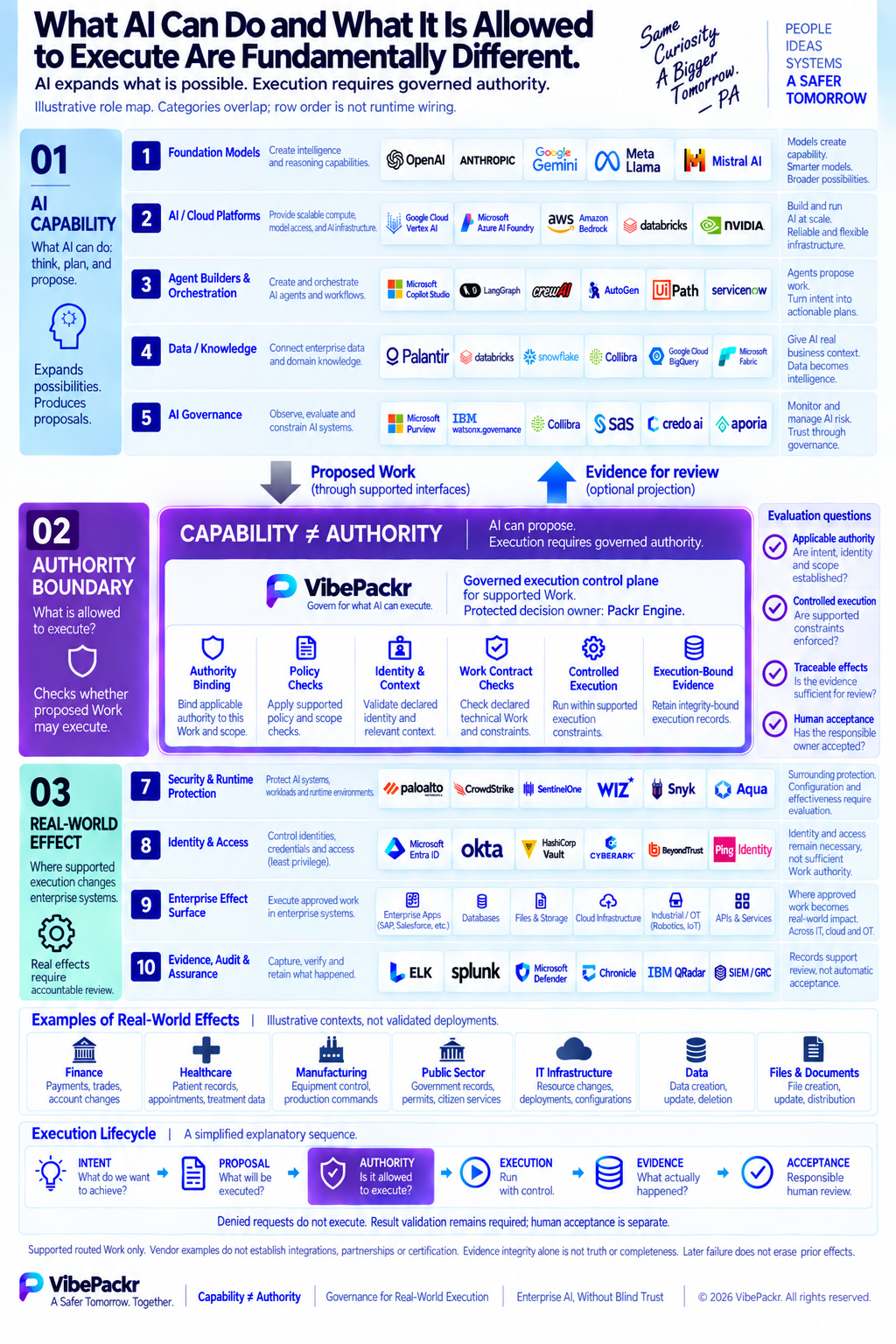
What AI Can Do and What It Is Allowed to Execute Are Different.
AI can propose. Execution requires governed authority. Explore the boundary between AI capability and real-world effects, and why a successful technical result is not sufficient evidence of authorization.
English technical whitepaper · 28 September 2026 · Figure 25 · Page 47; explanation · Page 49
AI capability and real-world effects are separated by a Work-specific authority boundary. This is an illustrative role map, not runtime wiring or a connector inventory. Coverage applies to supported routed Work. Identity and security remain cross-cutting controls; industry examples are not validated deployments. The simplified lifecycle does not remove result validation or separate human acceptance. Read the full explanation on page 49 and the primary operating model on pages 8-9.
What AI Can Do and What It Is Allowed to Execute Are Different.
In ordinary applications, AI may appear to complete its job when a model makes a decision, invokes a tool or API, and receives a successful result. But in finance, healthcare, the public sector, manufacturing, and critical infrastructure—where state changes carry regulatory and operational consequences—200 OK, exit 0, or transaction committed does not by itself establish that an execution was authorized or properly governed.
What AI can do is a question of Capability. What it is allowed to execute is a question of Authority.
Mission-critical environments therefore require more than asking whether AI can perform a task. They must establish who or what requested it, under which identity and context, which policies and scope apply, whether execution authority actually exists, what was executed, and whether the resulting evidence is sufficient for verification and acceptance.
Capability ≠ Authority.
The ability to plan, select tools, or invoke APIs does not grant AI the authority to change real enterprise systems. As AI becomes more capable and connected to more systems, this distinction becomes more—not less—important.
The upper section of this map represents AI Capability. Foundation models, AI/cloud platforms, agents, data and knowledge systems, and AI governance expand what AI can understand, plan, and propose.
The lower section represents Real-World Effect. This is where accounts and transactions change, patient records are updated, infrastructure is modified, files and data are altered, and industrial systems actually act.
Between those two worlds sits an intentional Authority Boundary.
VibePackr is not intended to replace models, agent frameworks, IAM, security products, AI governance, or SIEM. It operates between the capabilities those systems provide and real enterprise effects as a Governed Execution Control Plane—determining whether proposed work may cross into controlled execution and binding that execution to evidence.
That is why the execution lifecycle does not end with Prompt → Tool Call → Success.
Illustrative contexts, not validated deployments, tested workflows or sector approvals.
Finance
Payments, trades and account changes
Healthcare
Patient records, appointments and treatment data
Manufacturing
Equipment control and production commands
Public sector
Government records, permits and citizen services
IT infrastructure
Resource changes, deployments and configurations
Data
Data creation, update and deletion
Files and documents
File creation, update and distribution
Read the diagram in detail
1. Foundation models
Provide model capability, not Work-specific authority. A capable model does not independently grant permission for a proposed operation.
Illustrative examples: OpenAI; Anthropic; Google Gemini; Meta Llama; Mistral AI.
2. AI and cloud platforms
Provide models, tools, managed services and infrastructure. Platform access and Work admission answer different questions.
Illustrative examples: Google Cloud Vertex AI; Microsoft Azure AI Foundry; AWS Amazon Bedrock; Databricks; NVIDIA.
3. Agent builders and orchestration
Build agents and coordinate workflows. Coordinating steps does not by itself authorize every effect those steps could produce.
Illustrative examples: Microsoft Copilot Studio; LangGraph; crewAI; AutoGen; UiPath; ServiceNow.
4. Data and knowledge
Supply authorized enterprise data and domain context. Access, processing rights, source accuracy and provenance still need their own owners.
Illustrative examples: Palantir; Databricks; Snowflake; Collibra; Google Cloud BigQuery; Microsoft Fabric.
5. AI governance
Observe, assess and constrain AI within the selected products' scopes. Governance and security controls can overlap; this map is not a vendor capability ranking.
Illustrative examples: Microsoft Purview; IBM watsonx.governance; Collibra; SAS; Credo AI; Aporia.
6. VibePackr
The protected Packr Engine evaluates applicable authority, policy and scope for supported Work. Permitted Work may execute within its supported constraints; denial stops that request. Result validation and bound evidence support review.
7. Security and runtime protection
Surrounding controls help protect the selected environment. Their presence, configuration and effectiveness are not established by a logo or architectural placement.
Existing IAM, PAM and secret-management responsibilities remain in place. Authentication and reachable resources are not sufficient Work-specific authority.
Applications, databases, files, cloud resources, industrial systems and APIs are illustrative target categories, not a tested connector inventory. Confirm the particular operation, supported interface and authority before use.
10. Evidence, audit and assurance
Records support technical, security and business review. Integrity, validation, human acceptance and closure remain distinct; an imported log does not retroactively authorize an operation.
Illustrative examples: ELK; Splunk; Microsoft Defender; Chronicle; IBM QRadar; SIEM and GRC categories.