
Packtory: detailed future knowledge architecture
Bounded local Packtory includes local discovery, consumption, revision and storage lifecycle functions with governed administration. This plate concerns the wider future hosted/sharing concept, not current remote-service availability.
Technical Whitepaper · EN and KR Editions · 18 October 2026 · Figure 12
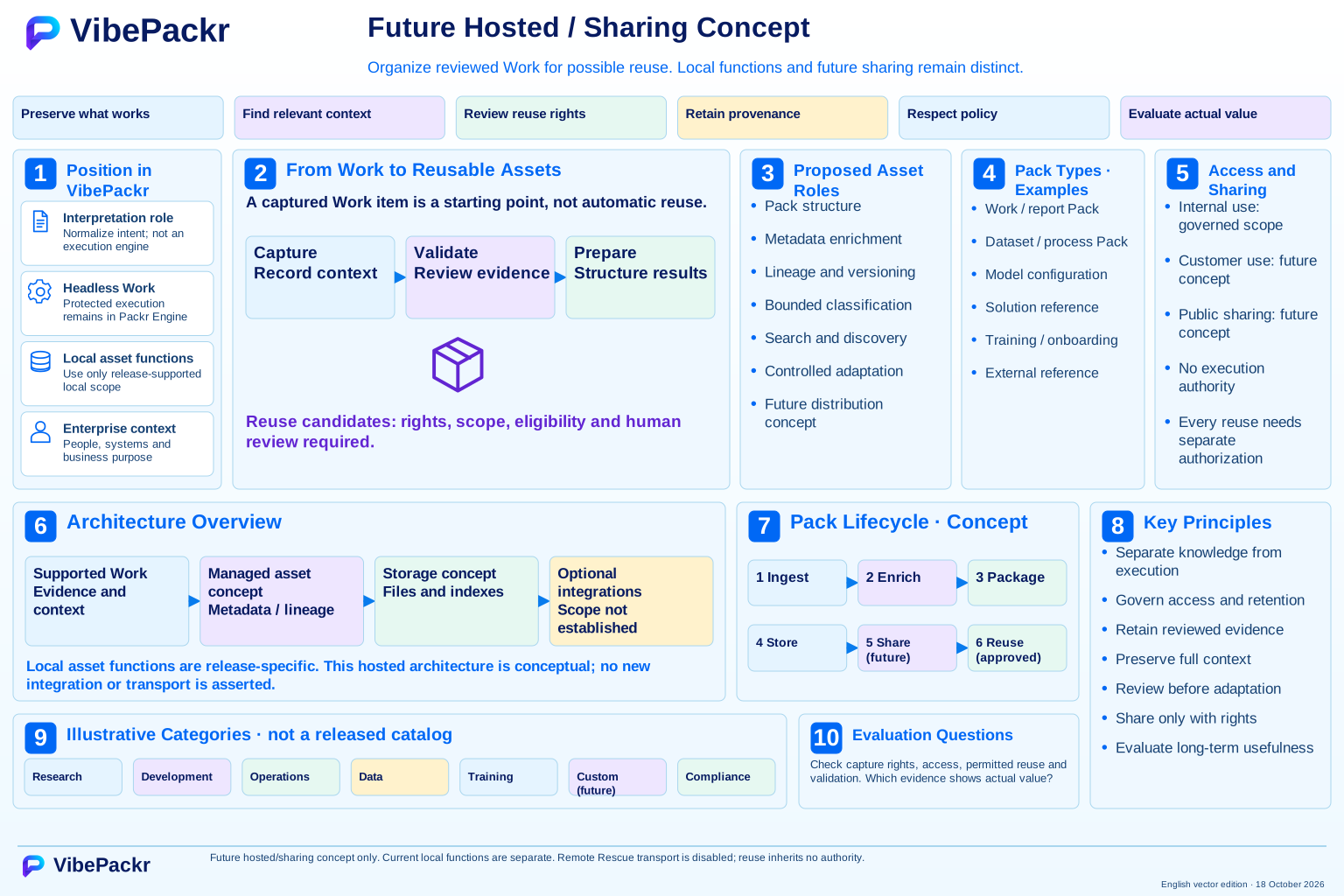
Open the full-resolution image to zoom; use your browser’s Back button to return. The complete plate is preserved; the explanation below remains readable without zooming.
Read the guide
A reading guide to the figure and its scope, not a claim of current implementation for every depicted concept.
Position and work-to-reference loop
The concept relates intent interpretation, governed execution, knowledge storage and the enterprise environment. Reviewed work could inform a later request, but does not transfer execution permission. Headless labels identify an operating surface, not a second protected authority or execution engine.
Proposed capabilities
The concept lists packaging, metadata, lineage, versioning, classification, search, adaptation and sharing. These proposed hosted/sharing roles are not a current service catalog.
Illustrative pack types
Work, report, dataset, process, model, solution, training and reference packs illustrate different knowledge shapes. The labels do not establish processing rights or production eligibility.
Access categories
Internal, customer-scoped and public sharing are concept categories. Storage, processing and redistribution rights must be evaluated separately; sharing never grants execution authority.
Proposed service architecture
Storage/versioning, enrichment, classification, search, reference handling and access form the conceptual services. External identity, collaboration and repository integrations are not asserted as available.
Lifecycle and review
Ingest, enrich, classify, package, store, review, reuse and feed back are conceptual stages. Review must precede reuse; a stored artifact is not automatically eligible.
Reuse eligibility
Policy, rights, sensitivity, provenance, scope and human review govern eligibility. Unknown or missing rights cannot be inferred from a successful prior operation.
Examples and objectives
The illustrated categories do not authorize ingestion of customer work. Rights, sensitivity, scope and eligibility require independent review. Bounded local Packtory is distinct from future hosted/sharing services; remote Rescue transport remains disabled.
About this reference
Figure 12 is provided as a current English SVG and included in both the English and Korean technical whitepapers dated 18 October 2026. Open the SVG to zoom, or use the PDF figure index to find the full plate.
Use this reference to understand architecture, responsibilities and planned capabilities. Use the applicable release documentation for deployment, and assign certification, legal and business acceptance decisions to your authorized reviewers.
Apply this boundary to one governed workflow.
Select one enterprise AI workflow, identify the required authority and policy conditions, and review the evidence needed before acceptance. Use the 11-step PoC guide or contact our architecture team to agree on the scope of your evaluation.
Contact boundary notice: Clicking “Request an Evaluation” opens your local email client addressed to support@vibepackr.com; it does not automatically create a support ticket or provision an environment. Please exclude credentials, personal data, and confidential logs.