The iceberg: four layers of execution architecture
Read the visible interface together with the less visible capability, governance and execution layers. This detailed reference preserves the original iceberg structure; it is not a Marketplace listing or an approval record.
Technical Whitepaper · English Edition · September 2026 · Figure 15
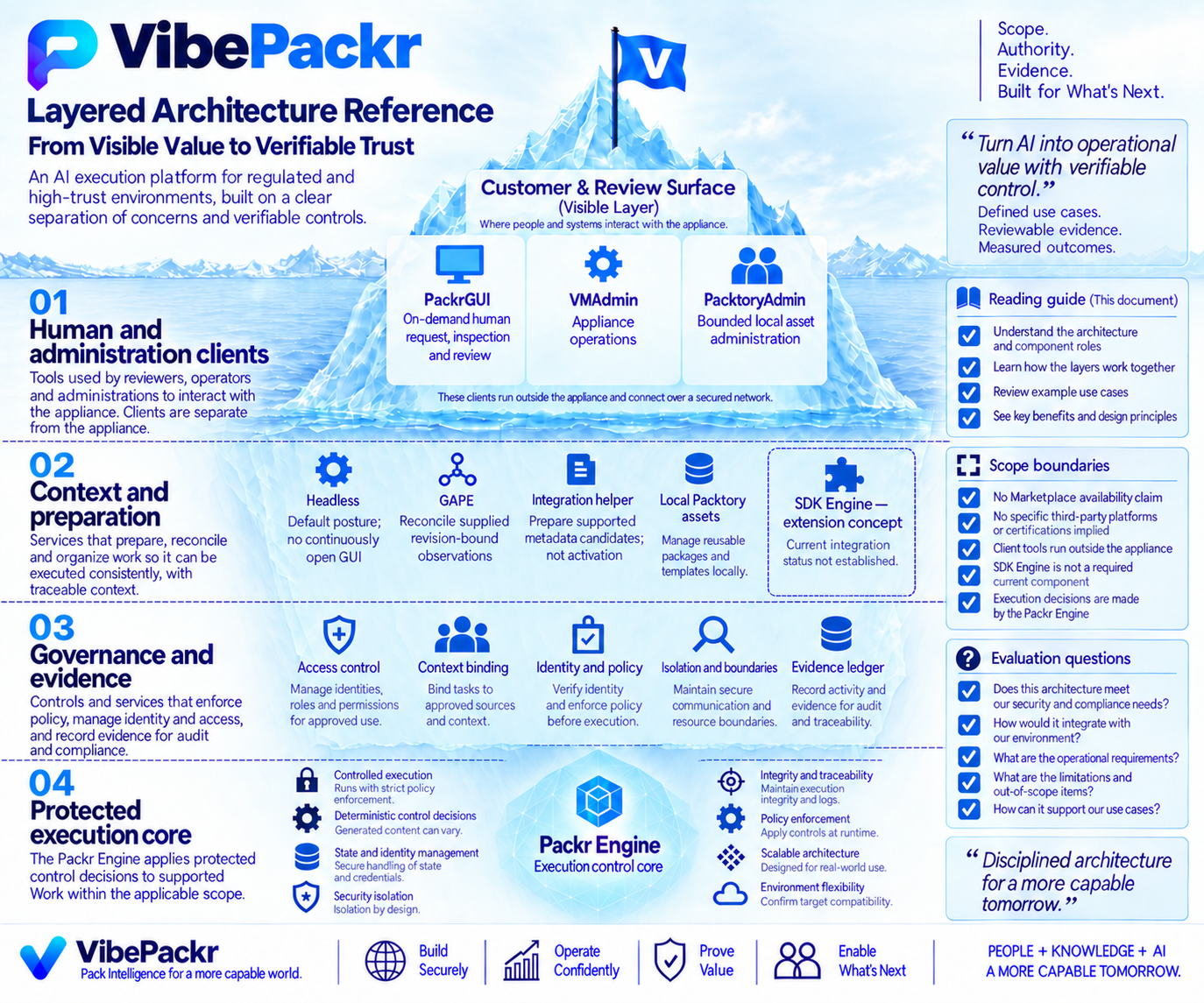
Open the full-resolution image to zoom; use your browser’s Back button to return. The complete plate is preserved; the explanation below remains readable without zooming.
Read the guide
A reading guide to the figure and its scope, not a claim of current implementation for every depicted concept.
Visible surface
The iceberg is a layered metaphor, not the primary current operating model. Headless is the default posture; PackrGUI is an on-demand human request and review client. Administration and status have separate scopes and no independent Work authority.
Capability layer
The context and preparation layer distinguishes Headless posture, bounded read-only GAPE, Integration Helper candidates and local Packtory assets. SDK Engine is an isolated architectural extension concept; current integration status not established. Bounded local asset functions do not establish future hosted or sharing services.
Governance and trust
Identity, permission, execution context, process identity, communication boundaries and evidence storage support bounded operations. Their presence in a drawing is not validation evidence.
Execution core
The deepest layer represents protected execution decisions, state handling, trust boundaries and evidence binding. Public labels describe roles without exposing internal implementation identifiers. Deterministic control decisions do not imply deterministic AI-generated content.
Evaluation questions
The right-hand panels ask reviewers to establish artifact identity, deployment readiness, supported interfaces, security boundaries, recovery procedures and traceability. They are questions, not completed review statuses.
Reference materials and limits
Use architecture, evaluation criteria, installation guidance, responsibility explanations and draft support terms together. The picture is not proof of Marketplace availability, commercial release, certification or production outcomes.
About this reference
Full composition from Figure 15 of the September 2026 English technical whitepaper. The full-resolution WebP preserves the source figure pixel-for-pixel; thumbnails are reduced previews only.
The whitepaper distinguishes bounded roles, conceptual architecture and future concepts. This reference does not establish release authorization, certification, legal approval or customer production outcomes.
Quick overview: the homepage uses a separate decorative iceberg. This page contains the detailed four-layer architecture reference.