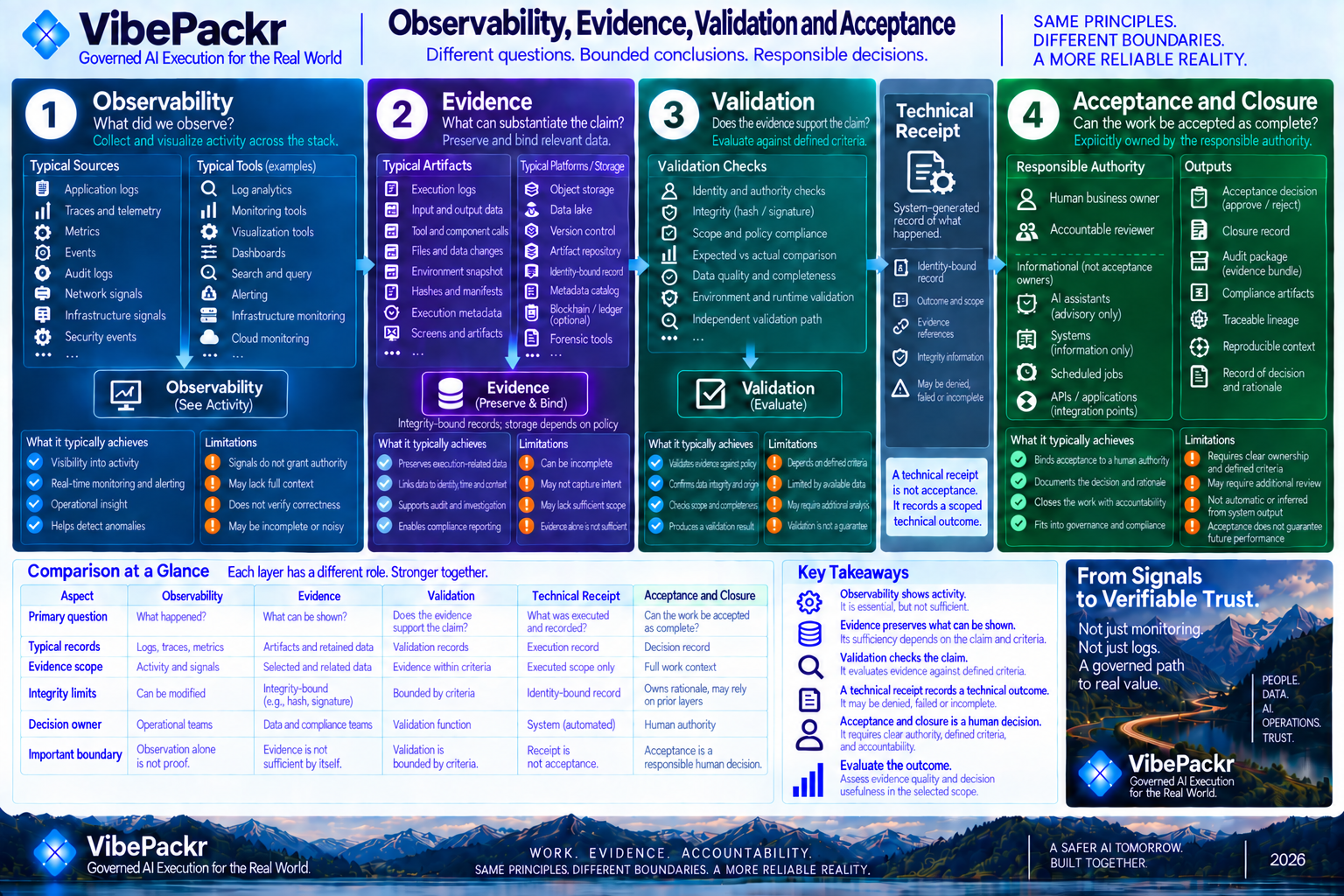
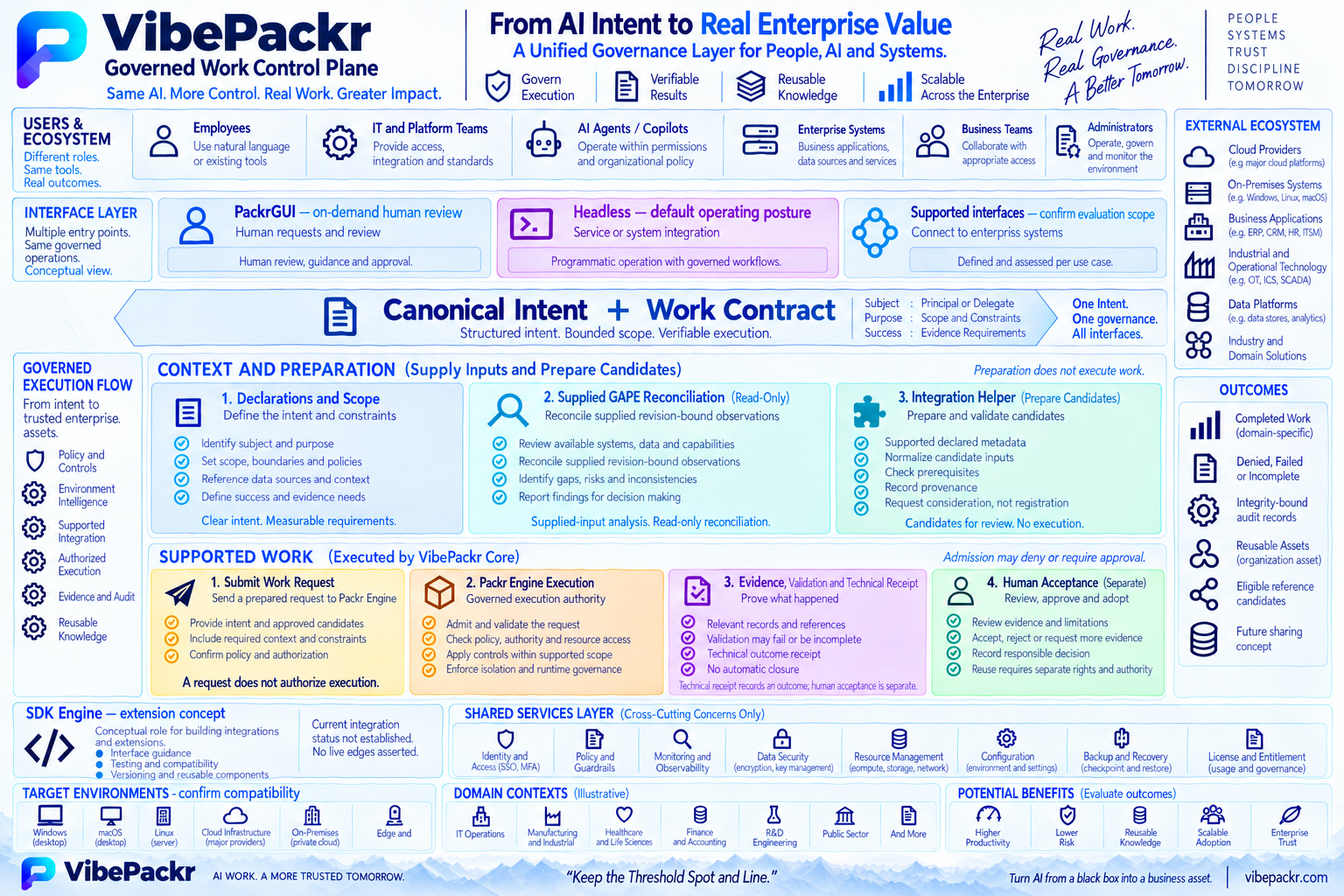
TECHNICAL ARCHITECTURE

How the pieces fit together.

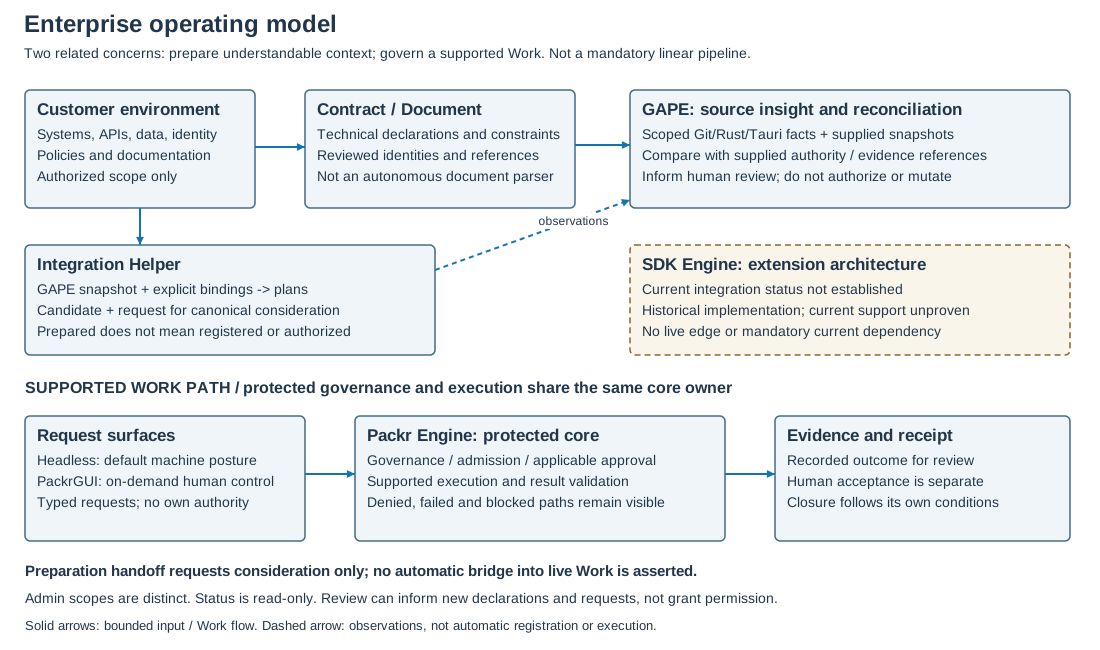
Start with the enterprise environment. Separate context and preparation from governed Work. Headless is the default operating posture; the protected Packr Engine owns governance and execution.

Explore workflow examples
CURRENT CAPABILITY SCOPE

Current implementation, explicit interface boundaries.

Work definition and document support

Contract carries typed intent, scope and constraints. Reviewed supporting material retains identity, digest and review state. Document Supporter describes this preparation role; a separately supported module under that name is not established. Neither declarations nor attached material grant permission.
GAPE source discovery and review

Operator R1 inspects explicitly scoped, committed Git blobs for bounded Rust static and Tauri registration/invocation relationships. Revision comparisons and offline HTML viewers are implemented. Headless inspection accepts supplied snapshots without fresh scanning; the current GUI projection remains R0.

Static source facts are not runtime effectiveness or authority. Dynamic constructs and source coverage have limits; no universal discovery or automatic remediation is claimed.

Helper architecture-bound planning

R2 consumes an exact GAPE R1 snapshot plus independent product, owner and authority bindings. Outputs include binding and validation plans, authority reconciliation, gap reports and a public-safe guide. Unknown or unsupported bindings remain not ready.

CLI submission has no trusted registration transport. Native registry admission is separate; registration is not Work binding. MCP transcript fixtures do not prove live provider connectivity. Generated scaffolds require implementation; the GUI remains R0.

Local assets and operating support

Local Packtory provides bounded discovery, revision and storage lifecycle functions. PacktoryAdmin addresses local administration; VMAdmin addresses appliance operations. Typed status reports state, bounded runtime selection prepares supported execution, and local sanitized diagnostic packages support review.

These are not hosted sharing, remote Rescue transport or independent authority engines. A local support package creates no additional service commitment.

SDK implementation is not current integration

Historical SDK Engine implementation exists. Current full Enterprise integration and support are not established; the current GUI contract defers the full SDK Engine. The supported Rust integration API is a separate surface, not proof of a fully integrated SDK Engine.

SDK is not a mandatory dependency of the reviewed core Work path. This is neither removal nor deprecation, and does not classify it as future-only.

One protected decision owner

Packr Engine owns relevant protected governance, execution, validation and evidence decisions. Headless, PackrGUI, administration clients and read-only status views consume product-owned results. A technical receipt is not human acceptance.

Current bounded source and component evidence are not release authorization, customer deployment proof, or Google Cloud Marketplace approval. Confirm versions and supported operations for the intended evaluation.

WHITEPAPER · CURRENT BOUNDED ROLES

One protected core. Separate preparation and Work paths.

The primary model explains responsibility, not a deployment inventory or released-package claim.

Primary operating model: context and preparation do not automatically enable Work. SDK Engine is an isolated architectural extension concept; current integration status not established. No live SDK connection is asserted.
Primary operating model: context and preparation do not automatically enable Work. SDK Engine is an isolated architectural extension concept; current integration status not established. No live SDK connection is asserted. Open full-resolution diagram →

Contract & document support

Typed technical intent, constraints, scope and reviewed supporting material prepare Work. They are not legal parsing, automatic prose-to-policy conversion or permission.

GAPE

A bounded read-only reconciliation and projection function, with separately scoped Git/Rust/Tauri source discovery, revision comparisons and offline viewers. Headless supplied-snapshot inspection and GUI R0 remain narrower interfaces.

Integration Helper

Prepares metadata candidates and R2 architecture-bound plans from GAPE snapshots plus independent bindings. Candidate provenance can also inform GAPE. A consideration request is not a proven live registration interface, binding or execution permission.

Headless & PackrGUI

Headless is the default posture. PackrGUI is an on-demand human request, inspection and review surface. Both remain subject to the protected core, not separate permission engines.

Packr Engine

The protected owner of governance and execution decisions for supported Work. Capability, connectivity, authentication and preparation do not independently authorize an operation.

Administration & status

VMAdmin concerns appliance operations; PacktoryAdmin concerns bounded local assets. Status and health are observations. These surfaces do not independently own Work authority.

SDK Engine: architectural extension concept; current integration status not established. It is not a mandatory current component, and this classification does not mean removed, deprecated or future-only.

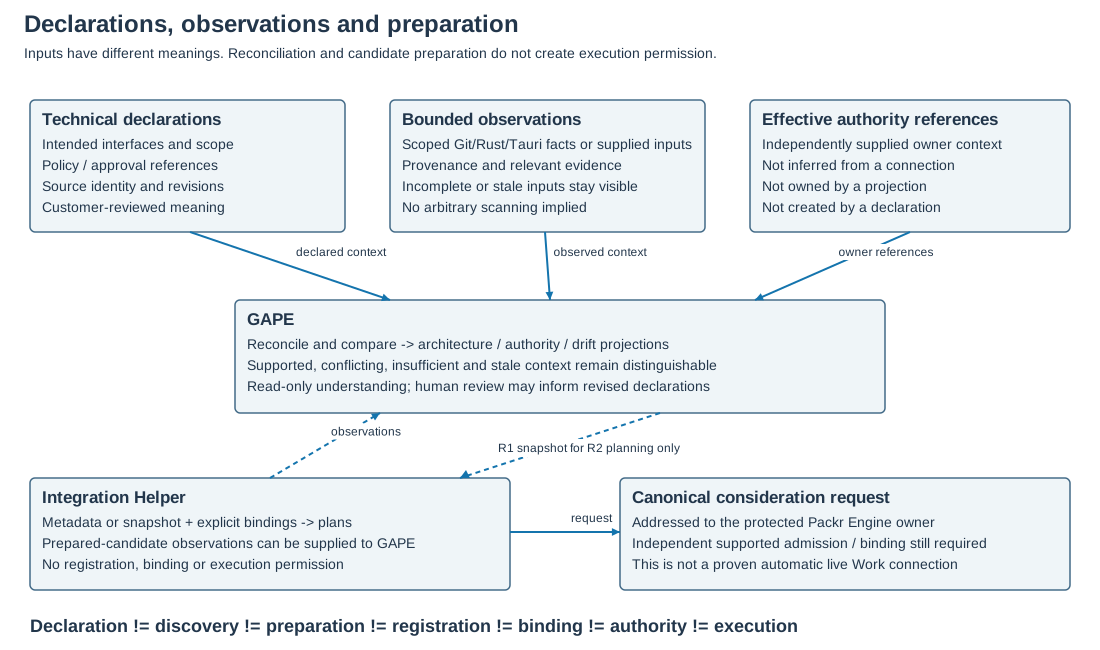
Declaration, observation and preparation are distinct. Helper can supply observations to GAPE; R2 also consumes a GAPE R1 snapshot with independent bindings for planning. The review loop is informational. A consideration request is not registration, binding or authority.
Declaration, observation and preparation are distinct. Helper can supply observations to GAPE; R2 also consumes a GAPE R1 snapshot with independent bindings for planning. The review loop is informational. A consideration request is not registration, binding or authority. Open full-resolution diagram →
SUPPLEMENTARY RESPONSIBILITY VIEW

Connect the operating model to your enterprise.

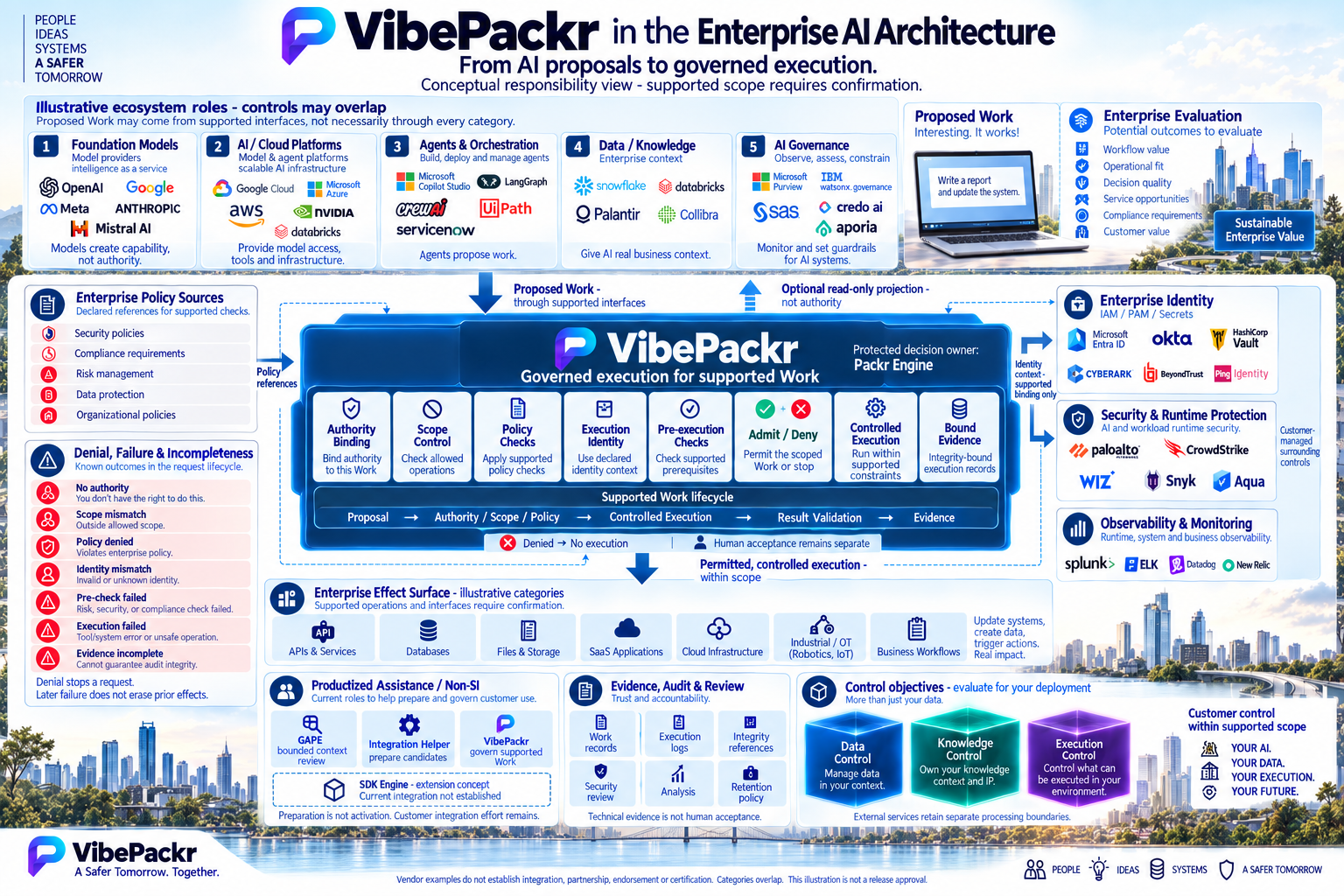
The primary model above defines the boundary. This expanded reference explains supported Work alongside identity, security, observability and customer responsibilities.

Detailed enterprise responsibility view showing optional preparation, declared policy references, Packr Engine governance, admission or denial, controlled execution, result validation, bound evidence, surrounding controls and an isolated SDK Engine concept with integration not established.

This is an explanatory responsibility view, not a current release inventory, connector catalog, certification, automatic integration pipeline or outcome guarantee. The primary operating model and supported interface contracts take precedence.

ENTERPRISE CONTROL STACK · TARGET ARCHITECTURE

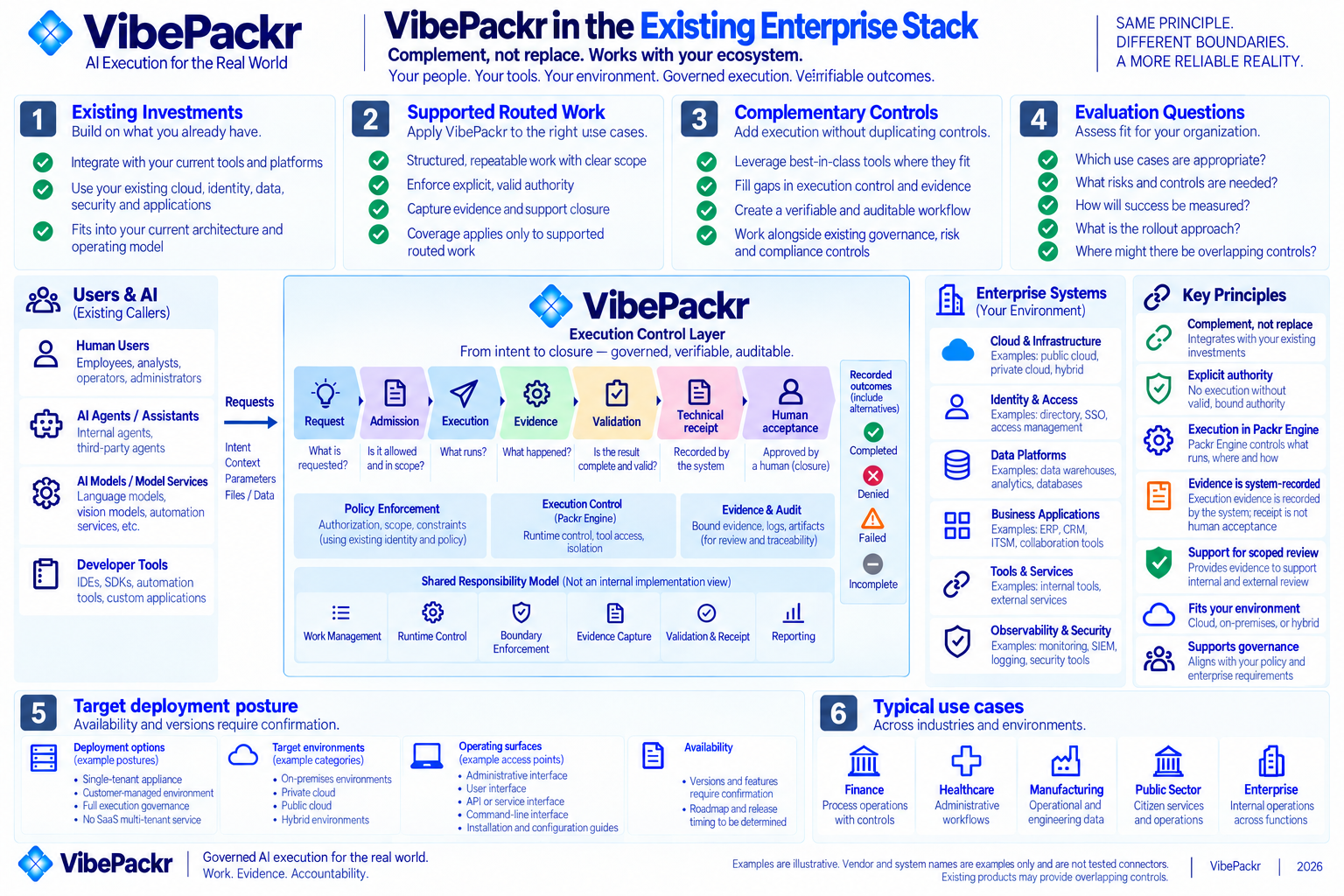
Complement the stack. Govern the work.

Identity, gateways, orchestration, and evidence systems have different responsibilities. Work-scoped authority connects them around a specific request.

Conceptual stack: existing identity and tools, agent orchestration, work-scoped governance, and evidence for outcome review. Text explanation follows.
Conceptual target architecture — not a product screenshot or deployment record. Named tools are illustrative ecosystem examples, not a verified integration list or endorsement. Outcome and compliance labels describe intended goals, not guarantees of correctness, regulatory compliance, or final acceptance. Confirm supported coverage for each evaluation. Open full-size diagram ↗
01 / DIFFERENT RESPONSIBILITIES

Gateway control ≠ work governance

A permitted API call is one event. Governing a work request also involves purpose, scope, execution constraints, and evidence. Responsibilities can overlap across products; this is a conceptual distinction, not a vendor capability ranking.

Gateway

Who may call which endpoint, and under what access or traffic policy?

Orchestration

Which steps and tools should be coordinated to carry out a task?

Work governance

Is this particular request authorized, what boundary applies, and what evidence supports review?

VibePackr's scope is limited to supported requests routed through its integrations. Existing IAM, gateways, and orchestration remain relevant controls.

Follow an illustrative request →
02 / EXPLICIT PERMISSION

Identity ≠ work-specific authority

Knowing who is acting and which resources they can reach does not, by itself, authorize every proposed operation. Authority must be evaluated for the specific work and its constraints.

  1. IdentityWho is acting?
  2. AccessWhat can they reach?
  3. AuthorityWhat is this work permitted to do?
  4. ExecutionWhat ran within that boundary?

An entitlement is not execution authority. Approval does not override policy, and a technical receipt does not grant final human acceptance.

Explore proposal and authority separation →
03 / CLAIMS NEED EVIDENCE

Logs ≠ a verified outcome

Observability, evidence, verification, and acceptance answer different questions. A record is useful only to the extent that it supports the claim being reviewed.

  1. ObservationWhat signals were captured?
  2. EvidenceWhich records support this claim?
  3. ValidationDo results meet declared criteria?
  4. ReceiptWhat technical outcome is recorded?
  5. AcceptanceWhat does the responsible authority accept?
  6. ClosureDoes the applicable process permit closure?

Tamper-evident hashes help detect changes. They do not independently prove business correctness, regulatory compliance, or customer acceptance. Verification is bounded by its evidence and criteria.

Review the illustrative evidence record →
Architecture Pillar 02

Keep Using AI Your Way.
VibePackr Controls What Actually Happens.

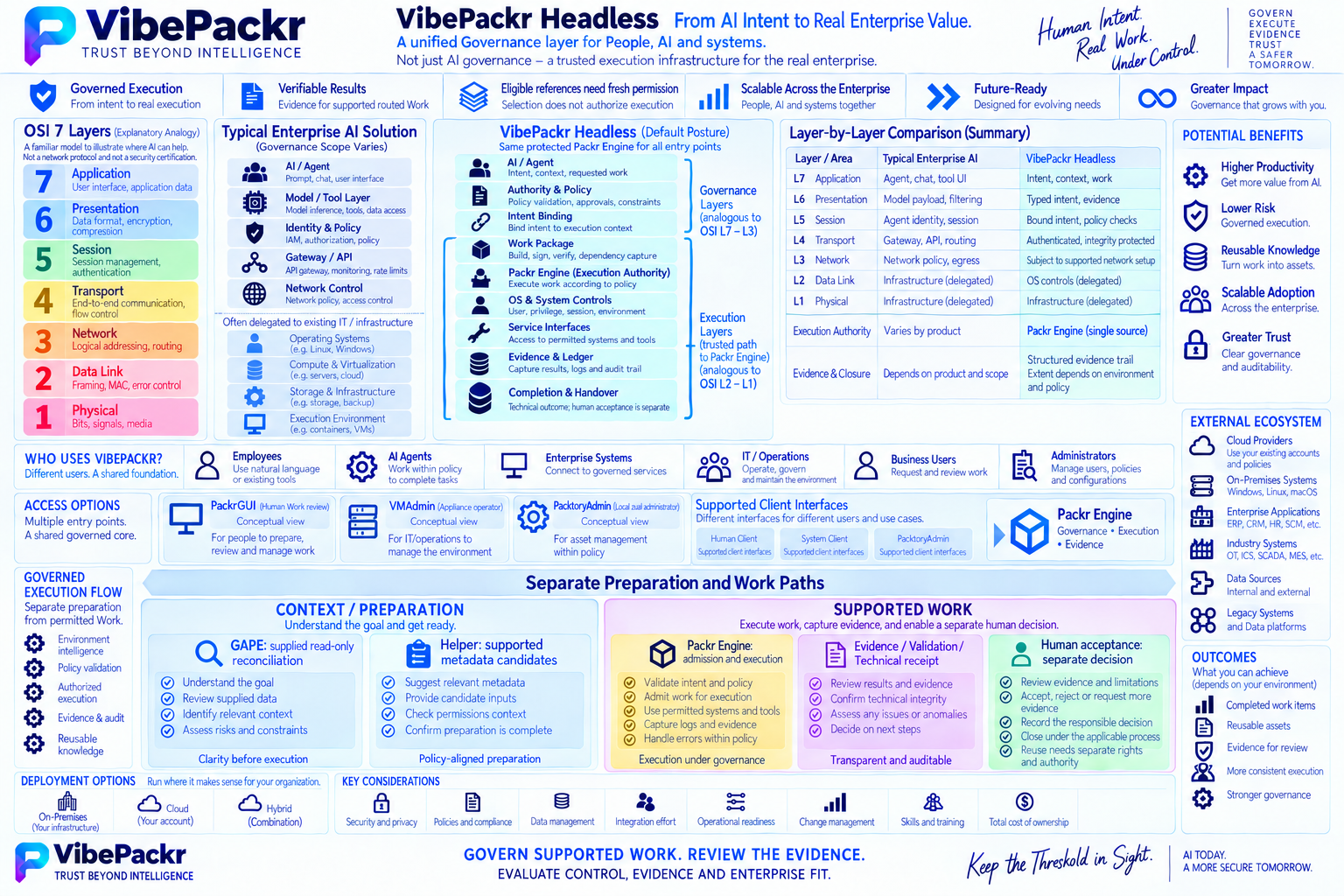
Developers and operators maintain their familiar tools and workflows. For action requests channeled through supported integrations, VibePackr operates headlessly in the background, evaluating execution boundaries.

Headless posture, governed Work and separate human review
Conceptual reference · Open full size
Pillar 02 • Headless by Default

Headless by default. Human interaction on demand.

Supported machine requests and typed operational queries do not require a continuously open graphical client. Only supported, scoped Work requests enter the governed execution path; this is not a universal API or scheduler claim.

✓
Confirm the evaluation scope: Supported platforms, interfaces, versions and runtime behavior must be established for the selected workflow.
✓
Real-World Execution Boundary: Action requests channeled through supported integrations are evaluated through Identity → Intent → Policy → Authority → Scope before reaching execution targets.
✓
On-demand PackrGUI: A human request, inspection and review client, not a required resident appliance GUI or an independent authority engine.
PRACTICAL WORKFLOW WALKTHROUGH

"How does this actually attach to my daily work?"

Explore an overview (00) and eight illustrative workflow stories (01–08): from an AI requesting a financial report, governed multi-agent resource access, explainable approval records, to bounded evidence and separate acceptance.

Open How It Works Guide (00–08) →
Architecture Pillar 03

BT-OS: Designing AI as System, Not a Model

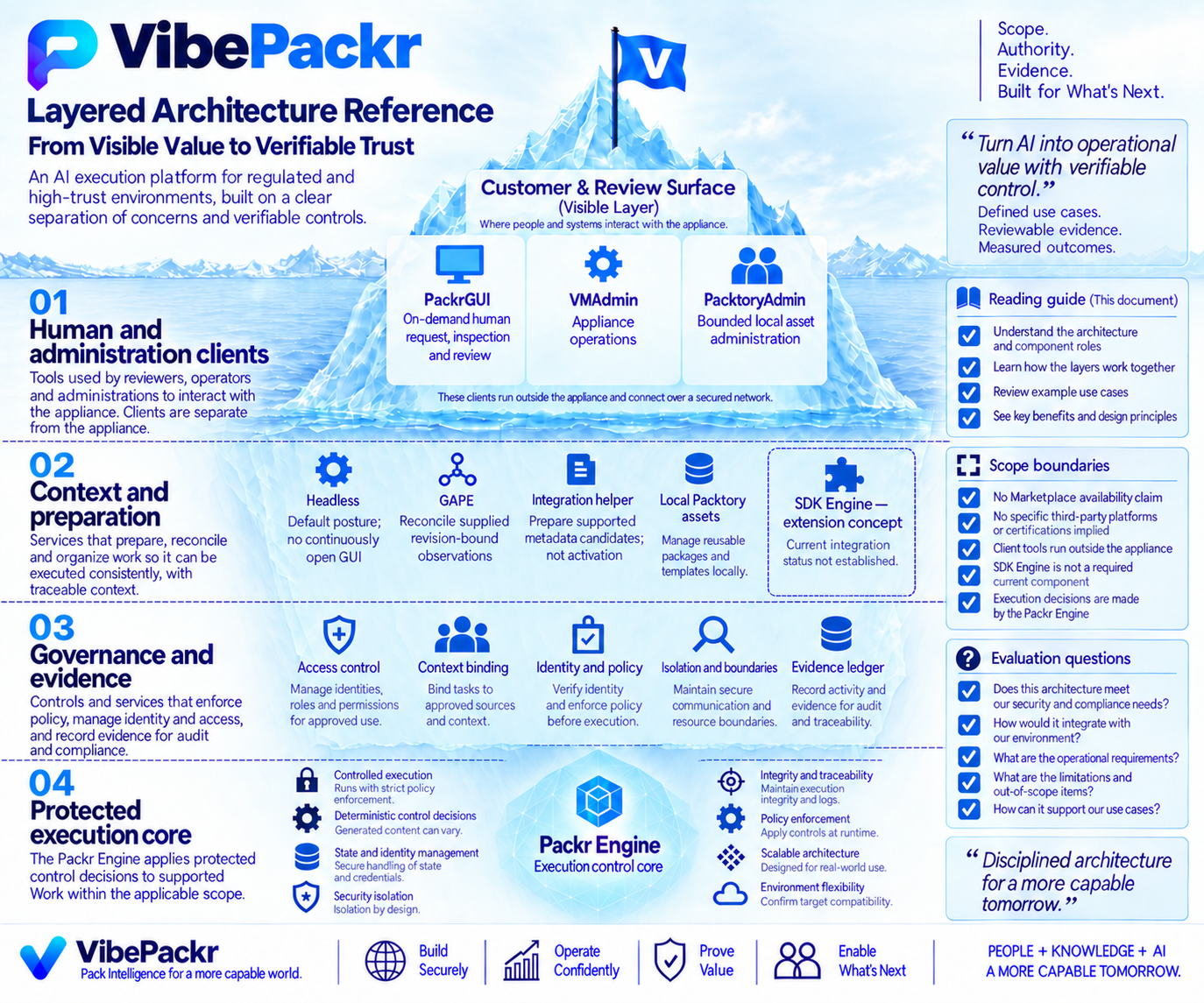
Models propose; the governed system evaluates whether a specific Work may proceed. VibePackr is not a model provider or replacement for the customer’s existing IAM, gateways and orchestration.

Layered architecture: visible surfaces, capabilities, governance and protected execution core
Conceptual reference · Open full size
Pillar 03 • BT-OS Operating Paradigm

Intent, context and explicit authority

BT-OS redefines LLMs as replaceable computational resources within a broader system architecture that explicitly structures knowledge and intent.

✓
Technical context: Declarations, observations and prepared candidates have different roles. None automatically registers, binds or authorizes a capability.
✓
Explicitly Structured Knowledge: Explicit knowledge structures and state records make context and supporting evidence easier to inspect; they do not guarantee model output accuracy.
✓
One protected decision owner: The protected Packr Engine owns governance and execution decisions. Proposals and projections cannot override its applicable authority boundary.
Architecture Pillar 04

Evidence supports a decision. It does not make it.

"Not another dashboard. A projection of what the system can prove."
A unified governed work record projected into distinct assurance perspectives for enterprise stakeholders.

The Governed Work Lifecycle

STEP 01
Request
STEP 02
Authority
STEP 03
Execution
STEP 04
Evidence
STEP 05
Verification
STEP 06
Receipt & Review

Step 01. Request (Intent Capture & Normalization)

User or automated request is captured, scoped, and normalized into a structured work intent. Capturing a request does not authorize its execution.

Key Evidence Artifact: Request Record / Normalized Work Intent
RECORDED
Observation, evidence and validation: each answers a different question
Conceptual reference · Open full size
Pillar 04 • Multi-Perspective Assurance

One Work Record, Multiple Assurance Views

A governed Work record supports different review questions. Observation, evidence, validation, receipt, acceptance and closure are distinct; a technical receipt is not human or business acceptance.

🔒
Security Team View: Authority decisions, execution isolation boundary enforcement, resource permissions, and tamper checks.
⚖️
Review View: Purpose, applicable criteria, validation references and technical receipts support review. They do not establish compliance, legal sufficiency or business acceptance.
⚙️
Operations View: Inspect supported status and health results, readiness and recovery dependencies. Historical success does not prove present readiness; service commitments are separate.
TARGET OPERATING MODEL

Customer-controlled. Headless-first. Explicit responsibilities.

A customer-controlled, single-tenant VM appliance is the enterprise target posture—not a completed customer deployment, approved Marketplace offer or production-readiness claim.

Deployment & clients

The headless appliance and human/administration clients have separate roles. Single-tenant describes an isolation objective, not one physical host or one user.

Productized Assistance

Standardize the boundary, not every customer's project. Custom adapters, migration, workflow design, cutover and operations need customer or implementation owners. Included product defects remain within applicable support scope.

Shared responsibility →

Recovery & resumption

Replaceable compute, persistent state, backups, access, keys and compatible versions are separate dependencies. Restored compute is not readiness, and readiness is not authority to resume Work. Validate state and permissions before resuming; no recovery-time, recovery-point, uptime or zero-loss guarantee is made.

Recovery boundaries →

Applicable law and executed agreements govern obligations. These explanations do not create support commitments, legal approval or managed operations. The public SLA remains a draft.

ENTERPRISE CONTROL ARCHITECTURE

Start with one supported, governed Work.

Define the authorized environment, supported path, approval requirements and evidence criteria. Evaluate negative and incomplete cases before considering wider adoption.

✓ Customer-controlled single-tenant VM appliance · Target posture
✓ Customer-controlled runtime and data-routing policies
✓ Technical receipts ≠ business acceptance
Contact: support@vibepackr.com