Enterprise evaluation: dependencies before expansion
Different enterprises begin from different conditions: an existing AI platform, a governance gap across the enterprise stack, or assurance pressure. These are illustrative starting points, not customer case studies, a delivery schedule or a mandatory SDK pipeline.
Technical Whitepaper · English Edition · September 2026 · Figure 13
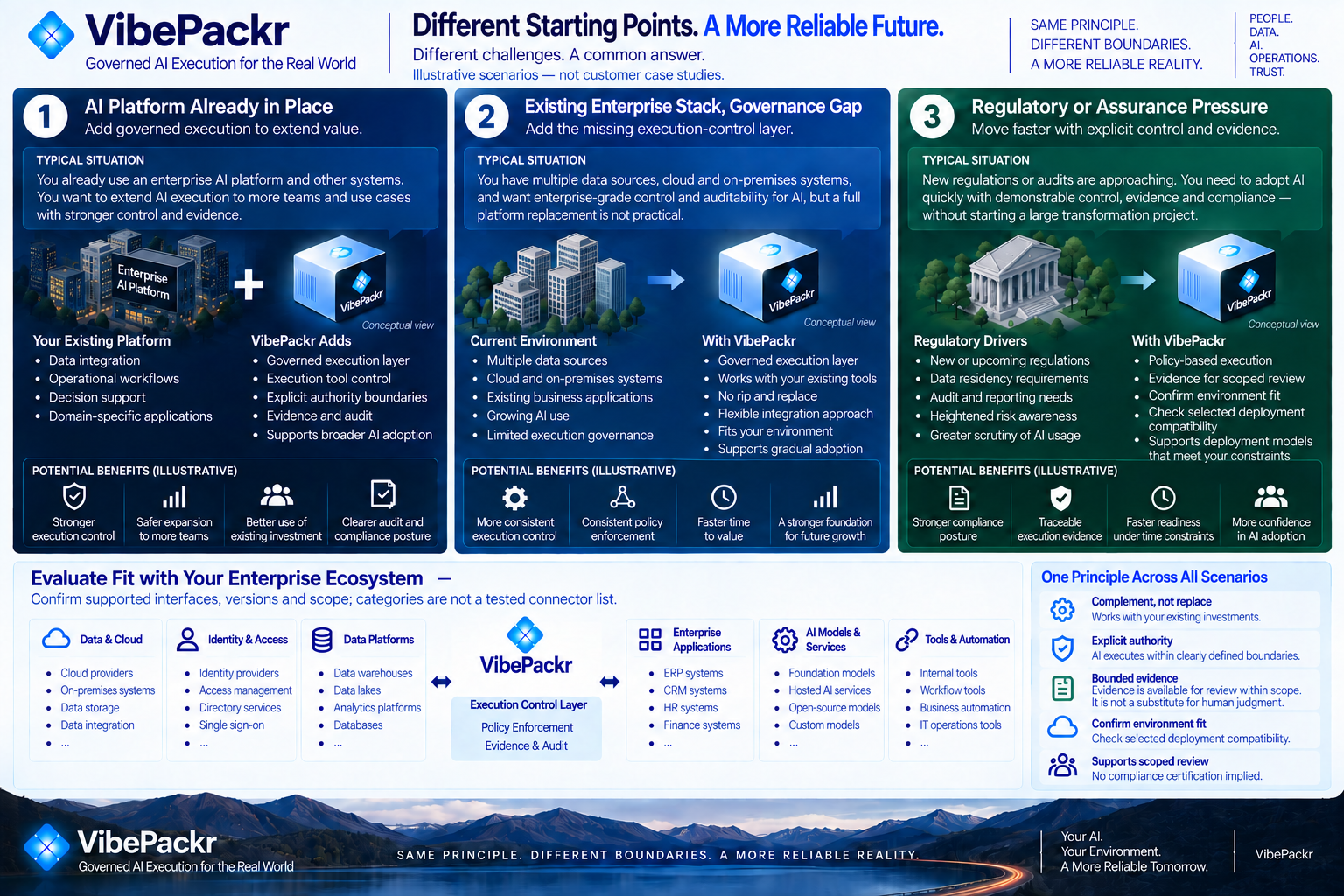
Open the full-resolution image to zoom; use your browser’s Back button to return. The complete plate is preserved; the explanation below remains readable without zooming.
Read the guide
A reading guide to the figure and its scope, not a claim of current implementation for every depicted concept.
1 · AI platform already in place
Explore a bounded execution-control layer alongside an existing platform. Existing data integration or decision support does not by itself authorize a new Work request. Potential benefits remain hypotheses for evaluation.
2 · Existing enterprise stack, governance gap
Select one useful workflow across the existing systems. Confirm supported interfaces, versions, rights and accountable implementation owners; the diagram does not promise universal integration or a replacement-free project.
3 · Regulatory or assurance pressure
Define the review criteria, deployment constraints and evidence needed for the relevant decision. Execution controls support scoped review; they are not compliance certification or a substitute for responsible judgment.
Evaluate ecosystem fit
Cloud, data, identity, applications, models and automation are illustrative context categories, not a tested connector list. Confirm the exact supported environment and integration scope.
Test before expanding
Agree owners, permitted inputs, admission conditions and outcome criteria. Evaluate denial, missing prerequisites, failed checks and incomplete evidence as well as the intended path. Wider rollout requires a separate readiness and acceptance decision.
Conditional extension, not a mandatory pipeline
An existing supported path may need no new adapter. Custom development needs an implementation owner and compatibility evidence. SDK Engine current integration status not established; extension is not a mandatory adoption stage or a promised delivery timeline.
About this reference
Full composition from Figure 13 of the September 2026 English technical whitepaper. The full-resolution WebP preserves the source figure pixel-for-pixel; thumbnails are reduced previews only.
The whitepaper distinguishes bounded roles, conceptual architecture and future concepts. This reference does not establish release authorization, certification, legal approval or customer production outcomes.