Deployment and recovery: compute, storage and validation
This target model explains recovery dependencies. It is not an installation runbook, supported-version matrix, or operational recovery guarantee.
Technical Whitepaper · English Edition · September 2026 · Figure 11
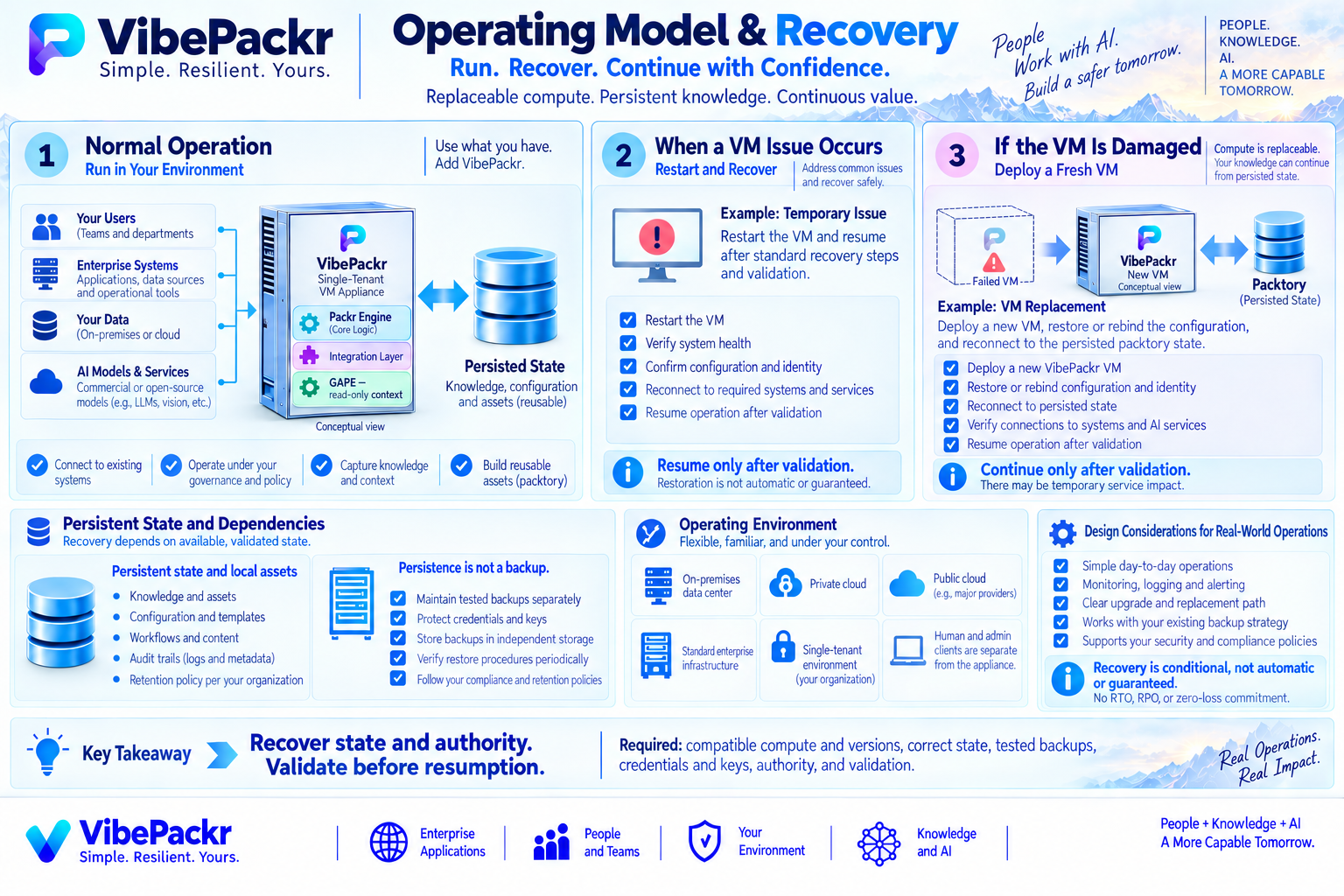
Open the full-resolution image to zoom; use your browser’s Back button to return. The complete plate is preserved; the explanation below remains readable without zooming.
Read the guide
A reading guide to the figure and its scope, not a claim of current implementation for every depicted concept.
Deployment topology
The target is a customer-controlled, single-tenant headless VM appliance with separate human/admin clients. Compute, persistent system/evidence data and tested backups are different concerns. Future hosted storage is not a current remote service.
Readiness before resumption
Establish the supported environment, identity, access, runtime, policy and scope; then validate readiness. SDK Engine is not a prerequisite. Restored compute is not readiness, and readiness does not authorize Work.
Temporary interruption
The restart path calls for restarting the runtime, checking health, verifying configuration and identity, re-establishing connections, and validating before operations resume.
VM replacement
The replacement path calls for compatible compute, restored or rebound configuration, reconnection to intact persistent stores, access and identity checks, and validation of intended operation.
Compute is not storage, and storage is not backup
A replaceable VM does not guarantee retained data. Recovery depends on intact data, usable credentials and keys, compatible versions, retention decisions and tested restoration procedures.
Resource and platform assumptions
Control-layer resource needs are separate from model inference hardware. Deployment targets, sizing and recovery procedures must be confirmed for the specific evaluation and release.
Evaluation objectives, not service commitments
The lower panels are objectives for evaluation and future operations. They are not measured benefits, a recovery-time objective, recovery-point objective, uptime promise or zero-loss guarantee.
About this reference
Full composition from Figure 11 of the September 2026 English technical whitepaper. The full-resolution WebP preserves the source figure pixel-for-pixel; thumbnails are reduced previews only.
The whitepaper distinguishes bounded roles, conceptual architecture and future concepts. This reference does not establish release authorization, certification, legal approval or customer production outcomes.