
Enterprise architecture: the complete picture
Use this overview to locate component roles. GAPE supports scoped source discovery and Integration Helper supports architecture-bound planning. Use Part.5 for local SDK authoring, and complete connection and execution checks separately. Consult your release manifest for the components actually supplied.
Technical Whitepaper · EN and KR Editions · 18 October 2026 · Figure 23
Figure 2 · Primary operating model
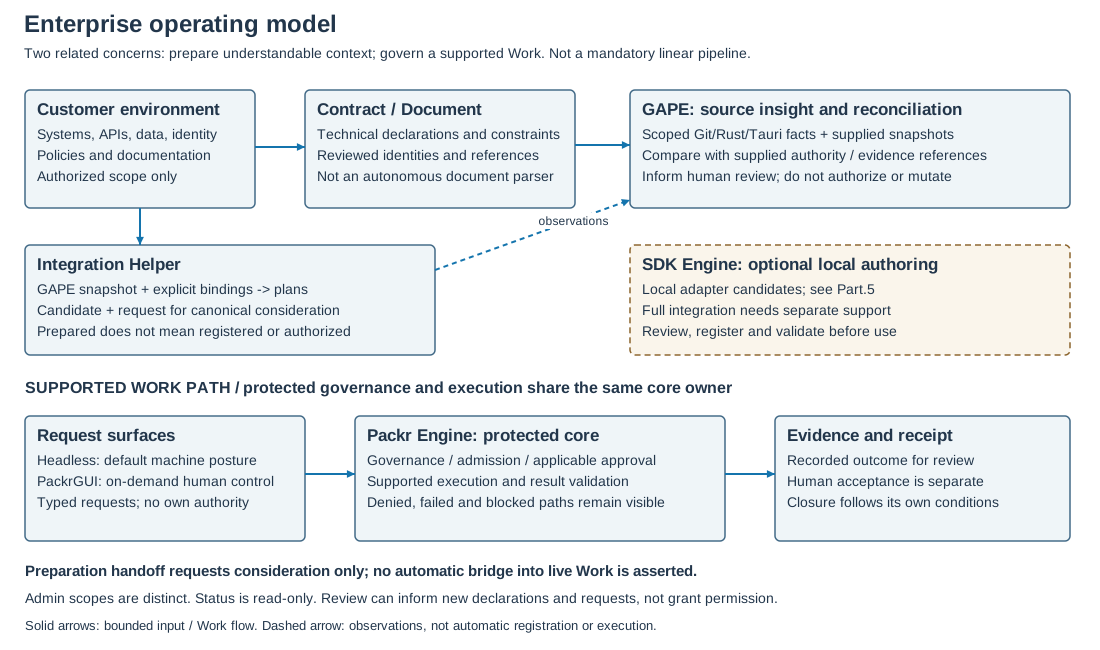
Figure 23 · Detailed operating model
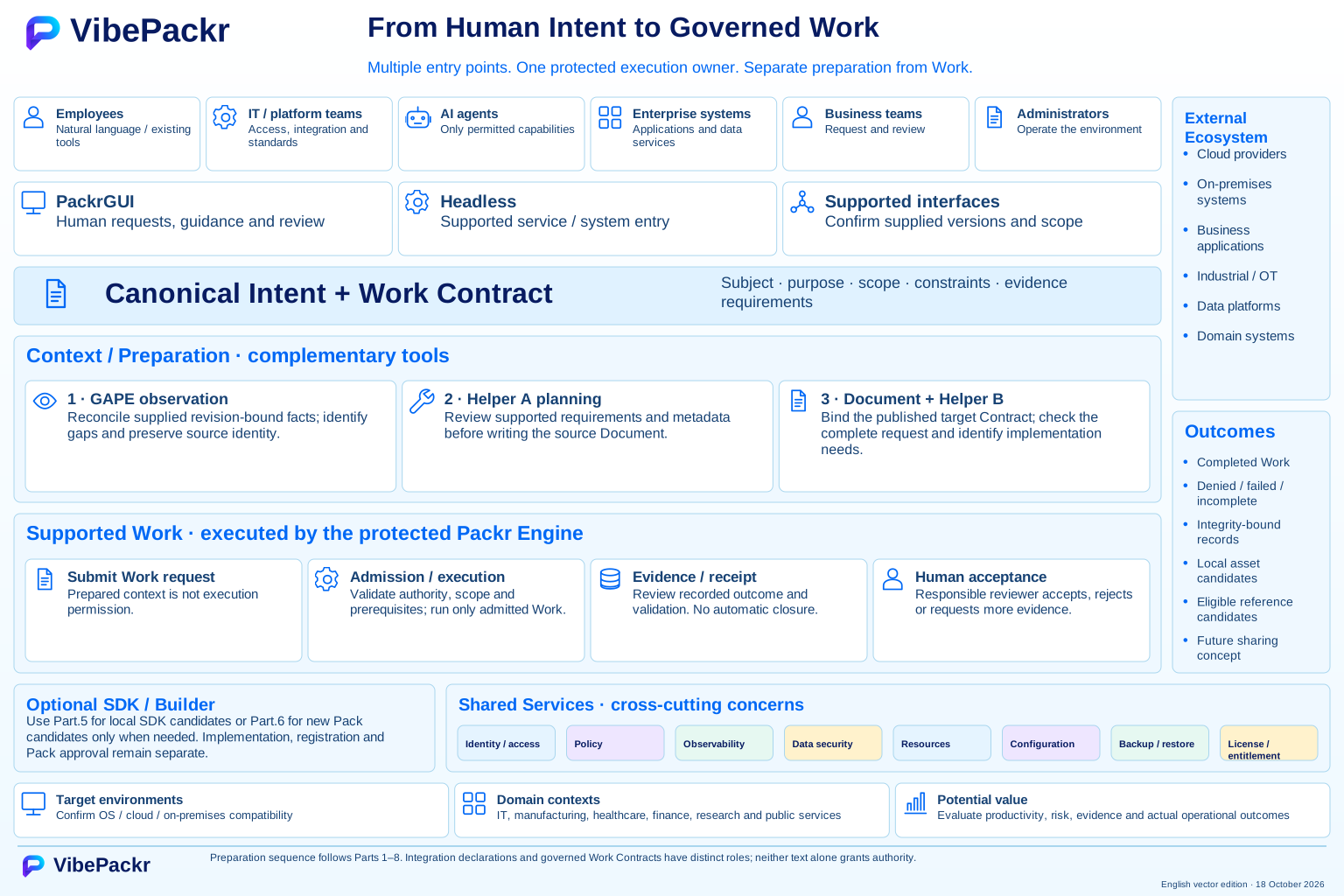
Open the full-resolution image to zoom; use your browser’s Back button to return. The complete plate is preserved; the explanation below remains readable without zooming.
Read the guide
A reading guide to the figure and its scope, not a claim of current implementation for every depicted concept.
Enterprise environment
Select authorized systems, data, interfaces, policies and accountable owners. Context categories are not a compatibility catalog.
Contract and document support
Technical declarations capture intent, scope and constraints; reviewed material supports Work preparation. Document Supporter names that role, not a separately established module. Neither grants authority or parses legal agreements into policy.
GAPE
Operator R1 provides scoped Git/Rust/Tauri static source discovery, reconciliation, revision comparison and offline viewers. Headless accepts supplied snapshots and GUI remains R0. These distinct interfaces do not grant authority.
Integration Helper
R2 prepares architecture-bound binding and validation plans from an exact GAPE snapshot plus independent owner and authority bindings. Metadata candidates can also inform GAPE. CLI submission has no registration transport; preparation is not binding or permission.
SDK Engine
Use the optional SDK Engine for local adapter candidates. Full Enterprise integration is a separate implementation and support scope; follow Part.5 and the requirements supplied with your package.
Headless and human surfaces
VibePackr runs headless by default; PackrGUI is on-demand for human requests and review. Admin and status surfaces do not independently own Work authority.
Work, evidence and acceptance
The protected Packr Engine governs supported execution. Validation, technical receipt, acceptance and closure remain distinct.
About this reference
Figure 23 is provided as a current English SVG and included in both the English and Korean technical whitepapers dated 18 October 2026. Open the SVG to zoom, or use the PDF figure index to find the full plate.
Use this reference to understand architecture, responsibilities and planned capabilities. Use the applicable release documentation for deployment, and assign certification, legal and business acceptance decisions to your authorized reviewers.
Apply this boundary to one governed workflow.
Select one enterprise AI workflow, identify the required authority and policy conditions, and review the evidence needed before acceptance. Use the 11-step PoC guide or contact our architecture team to agree on the scope of your evaluation.
Contact boundary notice: Clicking “Request an Evaluation” opens your local email client addressed to support@vibepackr.com; it does not automatically create a support ticket or provision an environment. Please exclude credentials, personal data, and confidential logs.