
GAPE: source discovery, reconciliation and review
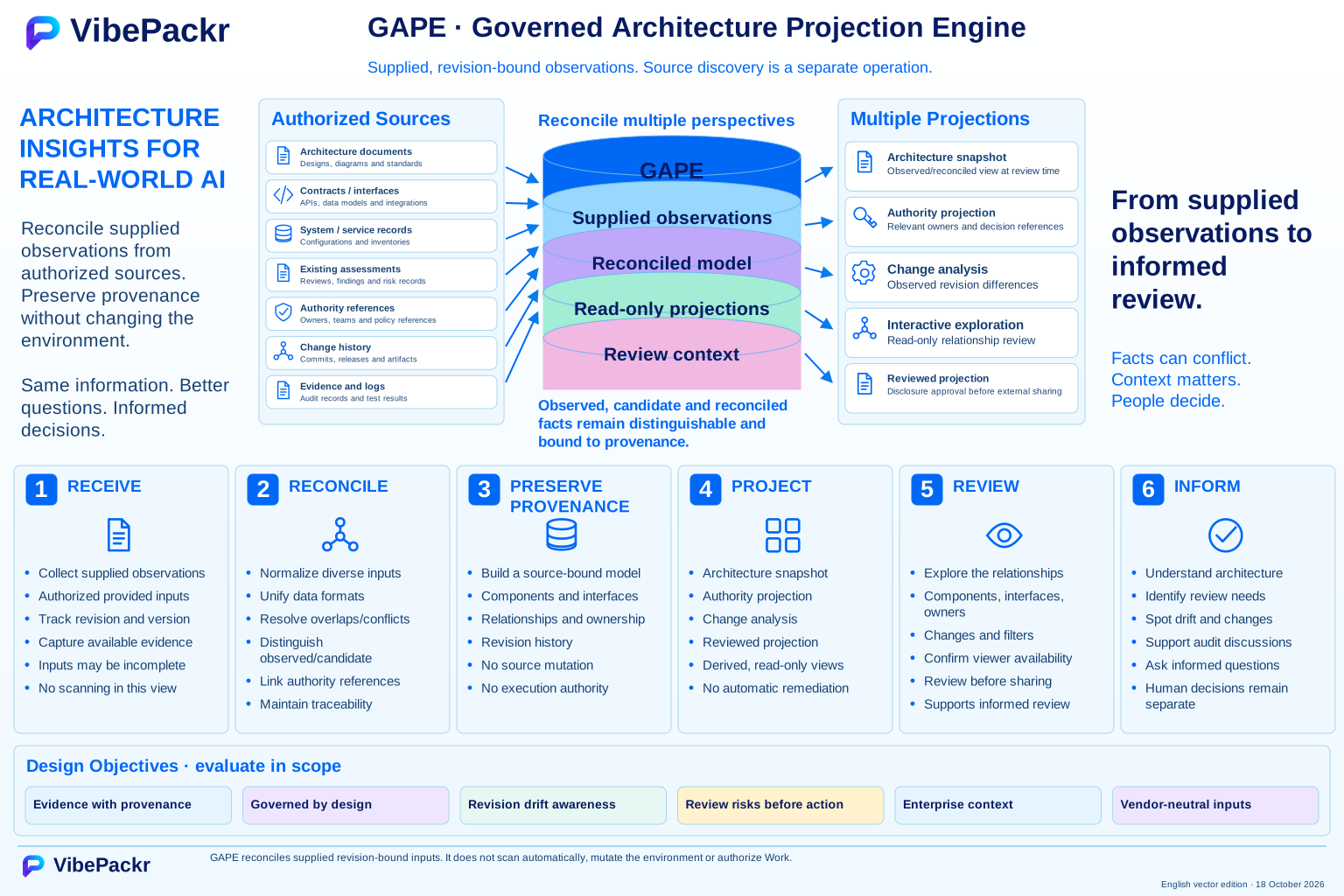
GAPE combines supplied-input reconciliation with separately scoped operator-side static source discovery. R1 compares revisions and provides offline HTML viewers. This plate preserves the supplied-input branch; its viewer imagery is conceptual.
Technical Whitepaper · EN and KR Editions · 18 October 2026 · Figure 4
Open the full-resolution image to zoom; use your browser’s Back button to return. The complete plate is preserved; the explanation below remains readable without zooming.
Read the guide
A reading guide to the figure and its scope, not a claim of current implementation for every depicted concept.
Authorized inputs
Inputs are bounded, supplied revision-bound observations and references, with explicit provenance and source permission. Contracts, registries, configuration, runtime, evidence and user context are source categories, not a universal adapter inventory.
Separate source-discovery operation
Operator R1 extracts bounded static Rust and Tauri registration/literal-invocation relationships from explicitly scoped committed Git blobs, preserving revision and source provenance. This operation is separate from the supplied-input branch pictured above. Static relationships do not establish runtime effectiveness or authority.
Reconcile
Normalize formats, connect related facts, map ownership and link revisions. Conflicts and missing evidence must remain visible rather than silently becoming facts.
Canonical model
The middle model records components, interfaces, relationships, ownership and provenance. Separate observed and expected state. This architectural model does not own product execution decisions.
Revision comparison and offline viewers
R1 implements revision comparison and offline HTML review views. The pictured interface remains conceptual. Internal source detail and allowlisted public-safe output are separate outputs; neither a picture nor a sanitized label proves disclosure safety.
Two preparation relationships, no activation
Helper can supply candidate provenance as observations. Separately, Helper R2 consumes an exact GAPE R1 snapshot with independent product, owner and authority bindings to prepare plans. Neither relationship registers a capability, binds Work or grants authority.
About this reference
Full composition retained from Figure 4, with three scope labels minimally corrected. This capability-aligned reference depicts the supplied-input branch; separate source discovery and actual offline viewers are explained here. The full-resolution WebP preserves the corrected source pixels; thumbnails are reduced previews.
Use this reference to understand architecture, responsibilities and planned capabilities. Use the applicable release documentation for deployment, and assign certification, legal and business acceptance decisions to your authorized reviewers.
Apply this boundary to one governed workflow.
Select one enterprise AI workflow, identify the required authority and policy conditions, and review the evidence needed before acceptance. Use the 11-step PoC guide or contact our architecture team to agree on the scope of your evaluation.
Contact boundary notice: Clicking “Request an Evaluation” opens your local email client addressed to support@vibepackr.com; it does not automatically create a support ticket or provision an environment. Please exclude credentials, personal data, and confidential logs.