
Governed execution: from request to review
Follow the whitepaper Work lifecycle from request to recorded outcome and review. Shared-resource and multi-agent scenarios still require workflow-specific evaluation; the plate is not scheduling coverage.
Technical Whitepaper · EN and KR Editions · 18 October 2026 · Figure 7
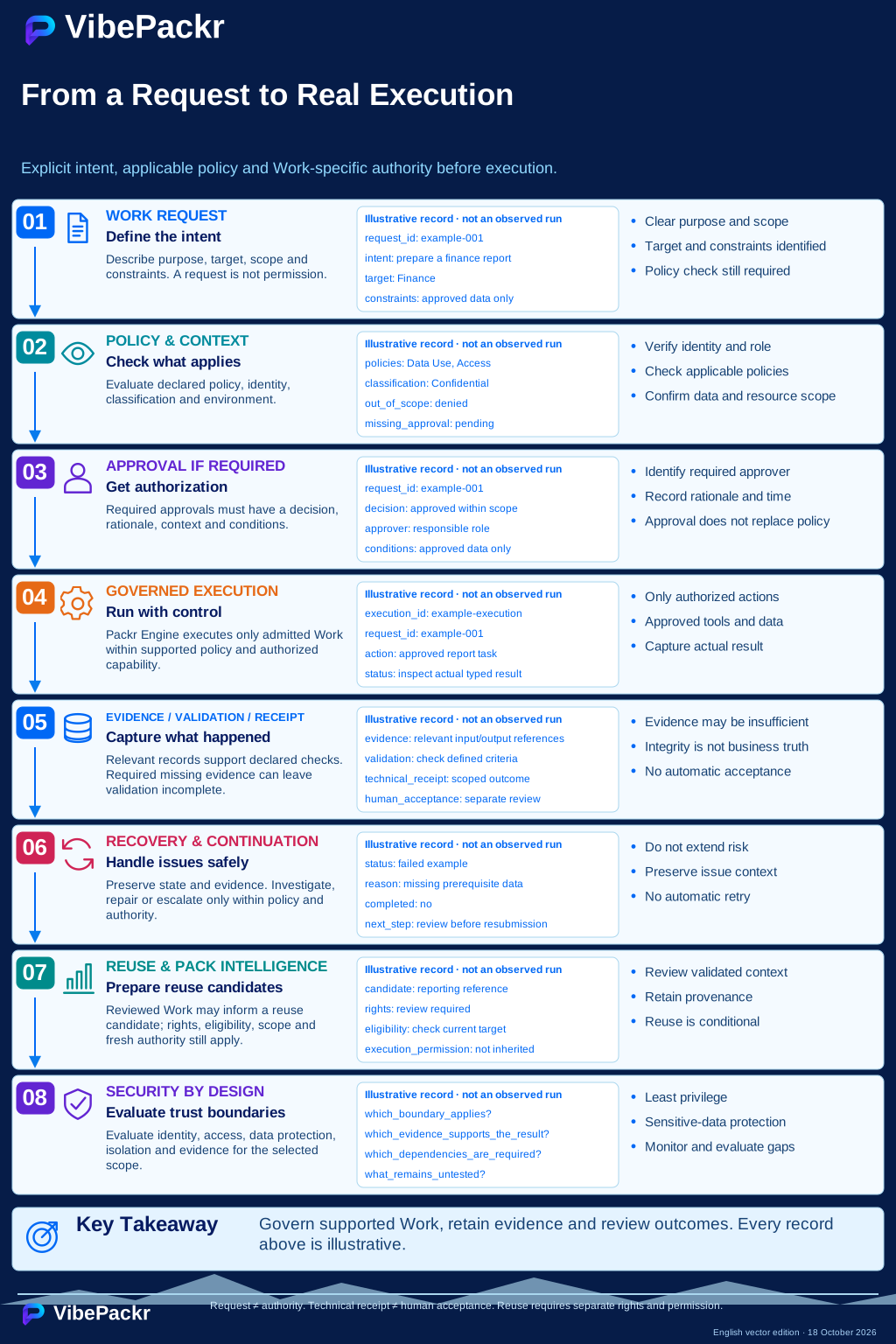
Open the full-resolution image to zoom; use your browser’s Back button to return. The complete plate is preserved; the explanation below remains readable without zooming.
Read the guide
A reading guide to the figure and its scope, not a claim of current implementation for every depicted concept.
1 · Work request
Identify the intent, purpose, target, scope and constraints. A request is not permission to execute; the reporting example is illustrative, not ERP compatibility evidence.
2 · Policy and context
Evaluate identity, rights, classification, scope and relevant prerequisites against the applicable policy. Access to a model or tool does not authorize the Work.
3 · Approval, if required
Some Work requires an additional approval under the policy. Record its owner, scope and conditions. Approval is a governance condition, not a replacement for policy; not all Work requires approval.
4 · Governed execution
The protected Packr Engine governs the supported, authorized path. Execute only within the admitted scope; specific isolation and coverage require evaluation.
5 · Evidence, validation and receipt
Capture relevant records and compare results with declared criteria. Evidence and validation can be incomplete. A technical receipt records an outcome, not business acceptance or automatic closure.
6 · Recovery and continuation
Stop and preserve relevant evidence when something goes wrong. Review the failure and decide whether to correct, retry or escalate within policy. Recovery is a governed decision, not an automatic restart.
7 · Reuse and Pack intelligence
A prior result may inform a reusable candidate only after rights, scope and eligibility review. New execution requires fresh authority; successful Work is not automatically reusable knowledge.
8 · Security evaluation
Assess the applicable identity, access, policy, isolation and monitoring controls for the selected scope. The drawing is not certification, tested universal coverage or a scheduler guarantee. For multi-agent Work, evaluate shared-resource risks separately.
About this reference
Figure 7 is provided as a current English SVG and included in both the English and Korean technical whitepapers dated 18 October 2026. Open the SVG to zoom, or use the PDF figure index to find the full plate.
Use this reference to understand architecture, responsibilities and planned capabilities. Use the applicable release documentation for deployment, and assign certification, legal and business acceptance decisions to your authorized reviewers.
Apply this boundary to one governed workflow.
Select one enterprise AI workflow, identify the required authority and policy conditions, and review the evidence needed before acceptance. Use the 11-step PoC guide or contact our architecture team to agree on the scope of your evaluation.
Contact boundary notice: Clicking “Request an Evaluation” opens your local email client addressed to support@vibepackr.com; it does not automatically create a support ticket or provision an environment. Please exclude credentials, personal data, and confidential logs.