
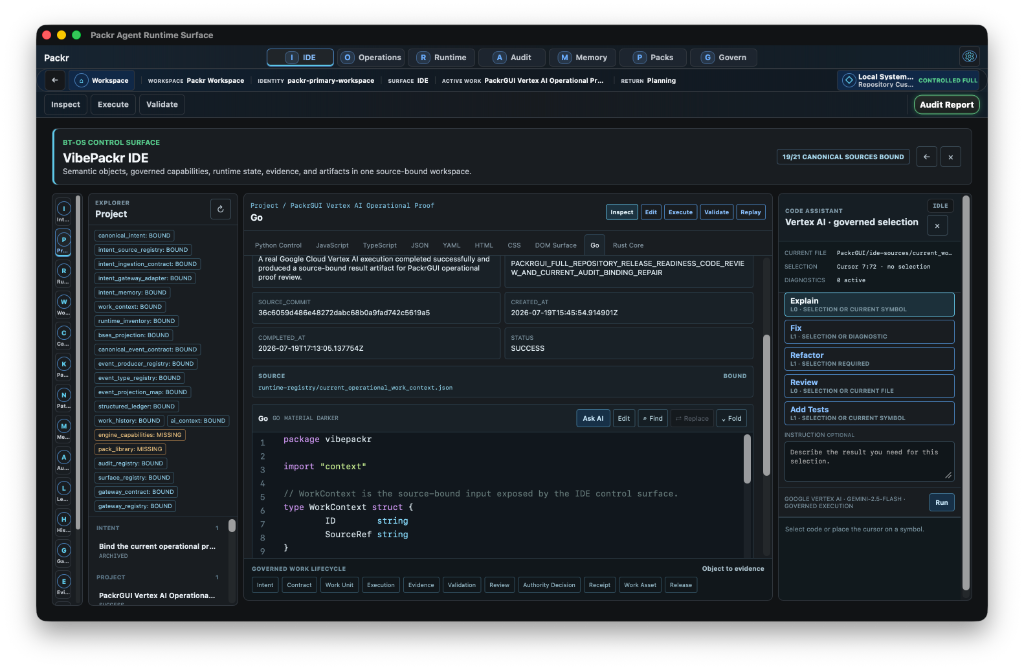
Reference architecture

Govern AI work without replacing AI infrastructure.

VibePackr keeps human control, canonical governance, runtime execution, validation, evidence, and operational memory distinct but continuously bound.

4 architectural layers8 lifecycle stagesExplicit authority boundaries
Layer model

One request. Four distinct responsibilities.

The architecture prevents presentation state, provider behavior, and governance decisions from collapsing into one opaque application layer.

01

Human control surface

Intent, inspection, review, approval, and visible state.

Presentation owner
02

Governance core

Contract, authority, policy, state, and canonical decisions.

Decision owner
03

Runtime binding

Models, agents, tools, providers, and execution environments.

Execution adapter
04

Validation & evidence

Observed results, validators, digests, work records, and receipts.

Proof boundary
Enterprise context

The governance layer completes the enterprise AI stack.

01

AI development & evaluation

How do we build reliable AI?

  • Data
  • Human feedback
  • Evaluation
  • Safety
  • Reliability
02

AI runtime

How do we execute AI?

  • Models
  • Agents
  • Tools
  • APIs
  • Execution environments
03

Governed work

How do we make AI work accountable?

  • Intent
  • Contract
  • Authority
  • Validation
  • Evidence
  • Receipt
04

Enterprise operations

How do we turn work into outcomes?

  • Ontology
  • Context
  • Processes
  • Decisions
  • Actions
Interactive Reference Architecture

Core components required to turn AI execution into governed work.

The canonical architecture keeps presentation, decision, execution, and proof continuously bound without assigning them the same owner.

01WORKSTATION

WORKSTATION

Human Control Surface
  • Intent
  • Review
  • Approval
  • Receipt
BOUNDARY CONNECTED
02GOVERNANCE CORE

GOVERNANCE CORE

Canonical Decision Layer
  • Contract
  • Authority
  • Policy
  • State Machine
CANONICAL OWNER
03RUNTIME BINDING

RUNTIME BINDING

Execution Adapter Layer
  • Model
  • Agent
  • Tool
  • Execution
BOUNDARY CONNECTED
04VALIDATION & EVIDENCE

VALIDATION & EVIDENCE

Proof and Record Layer
  • Validator
  • Digest
  • Manifest
  • Work Record
BOUNDARY CONNECTED
IDENTITY

Every object (Packs, receipts, policies, contracts) is cryptographically signed and perfectly traceable.

AUTHORITY

Every mutation, state shift, and tool execution is gated by explicit policies and authorized tokens.

LINEAGE

Every output, database insert, and validation result maintains full context trace back to its source prompt.

MEMORY

Every closed work unit can be audited, replayed, and learned from without violating security baselines.

Complete solution architecture

PackrGUI, PINM, BT-OS, runtime, and ecosystem in one English view.

This publication figure complements the interactive architecture by showing the full value flow, system boundaries, integrations, and lifecycle together.
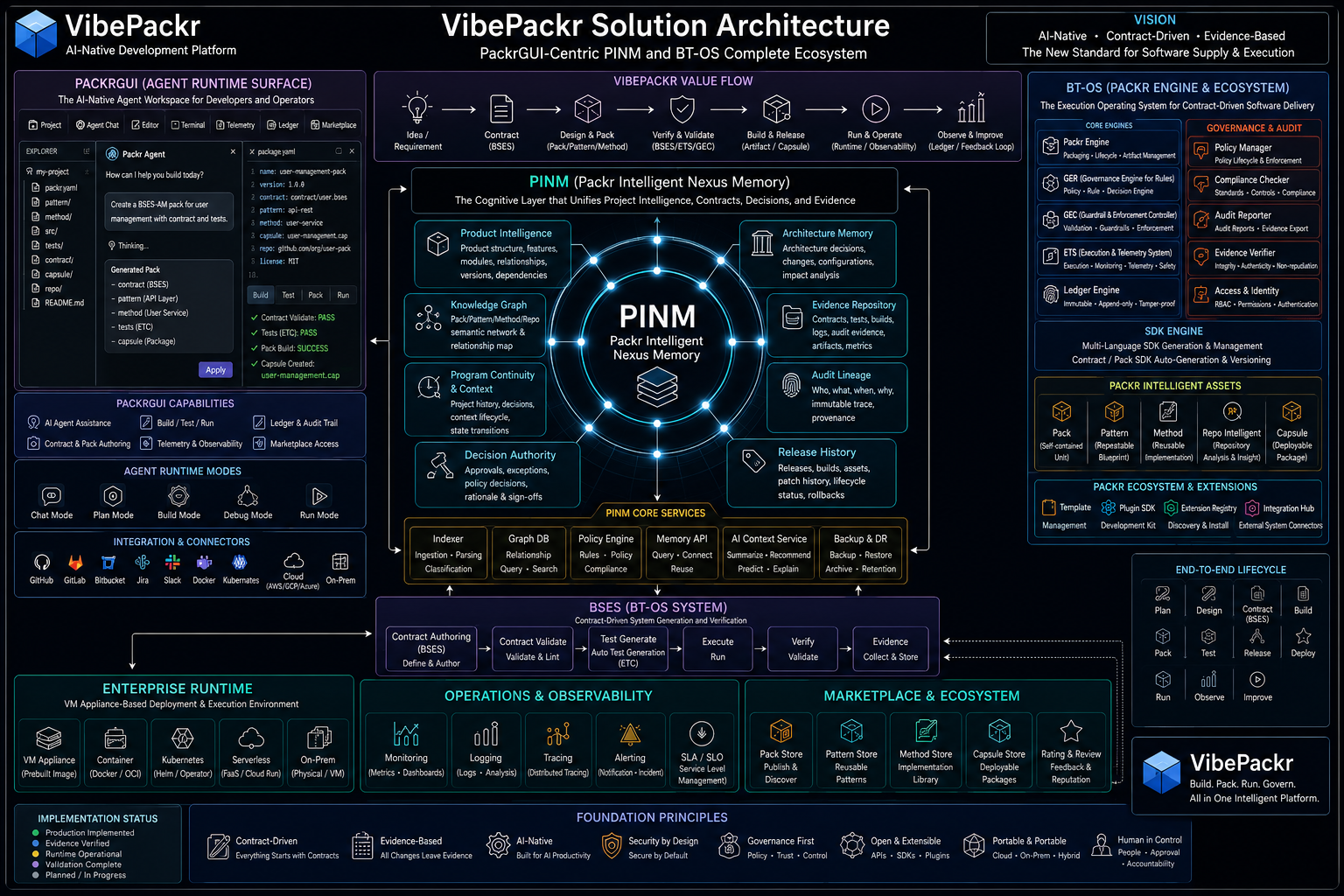
Zoom Available
English VibePackr solution architecture covering PackrGUI, PINM, BT-OS, BSES, runtime, and observability
VibePackr Solution Architecture
English final architecture reference for presentation and publication use.Open full resolution ↗
Canonical lifecycle

Each transition has an observable purpose.

  1. 01

    Intent

    Define the desired outcome

  2. 02

    Contract

    Set scope and success conditions

  3. 03

    Authority

    Resolve policy and permission

  4. 04

    Execution

    Run on the appropriate runtime

  5. 05

    Validation

    Test the observed result

  6. 06

    Evidence

    Bind proof to the work

  7. 07

    Receipt

    Record what happened

  8. 08

    Closure

    Accept, replay, or escalate

Claim discipline

The architecture separates what the system shows from what the evidence proves.

  • 01

    VibePackr governs work; it does not claim to replace AI runtimes or enterprise systems.

  • 02

    Evidence supports a claim only within the scope directly observed.

  • 03

    Human authority remains explicit for acceptance, production proof, and final receipt.

  • 04

    Provider, model, and execution claims are never inferred from presentation state.